In today’s fast-paced corporate world, organizations must deliver training efficiently, track performance, and scale learning across teams and that’s where an enterprise learning management system (LMS) becomes indispensable. If your business aims to empower employees, improve retention, and shorten ramp-up time, choosing the right LMS can make all the difference.
At NetSkill, we understand how crucial a robust learning ecosystem is for growth. This guide breaks down what an enterprise LMS is, why it matters, and how to choose one that transforms your business.
What Is an Enterprise Learning Management System?
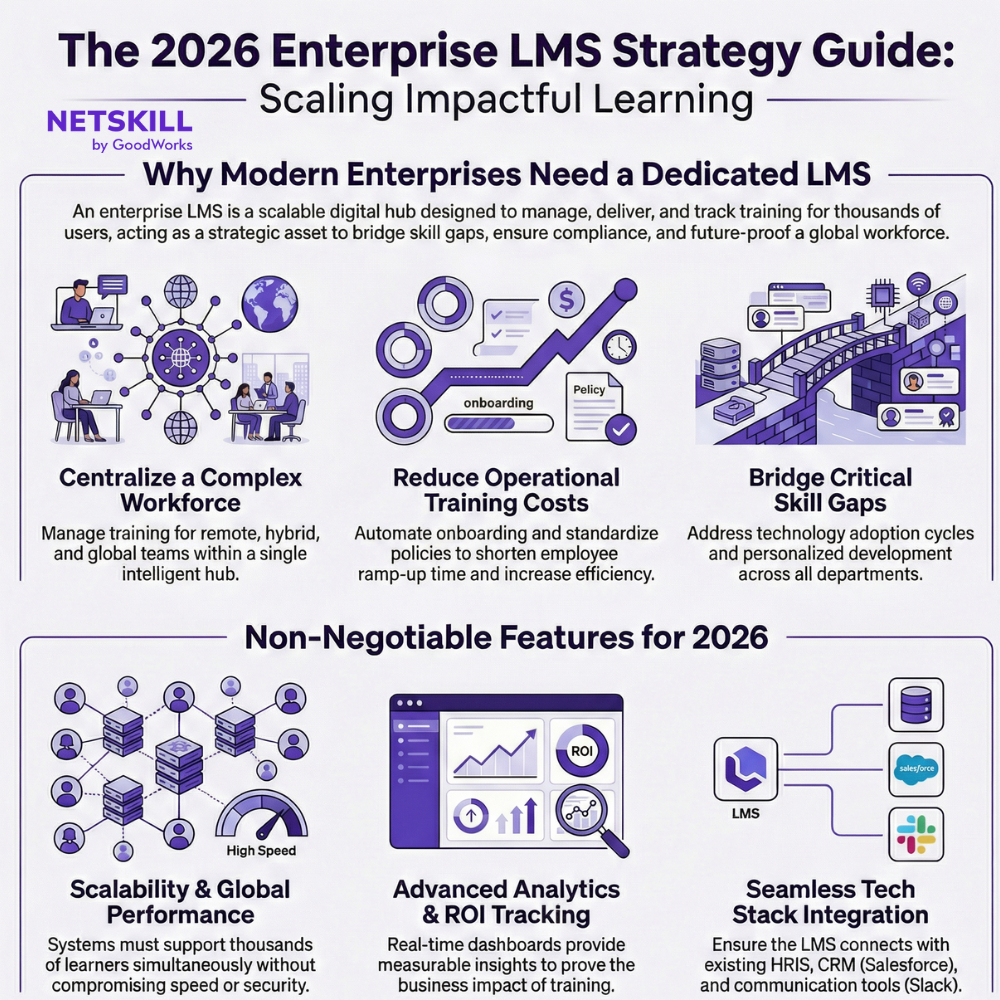
An enterprise learning management system is a scalable digital platform designed to manage, deliver, and track training programs across large organizations.
- Unlike small or mid-market LMS tools, enterprise LMS platforms offer:
- Support for thousands of users
- Advanced reporting and analytics
- Integration with HR, CRM & ERP systems
- Secure user management & single sign-on (SSO)
- Custom learning paths & competency frameworks
With an enterprise LMS, companies can centralize all learning activity in one intelligent hub.
Why Your Organization Needs an Enterprise LMS
Modern enterprises face complex challenges:
- Remote & hybrid workforce
- Compliance & certification tracking
- Fast technology adoption cycles
- Personalized employee development
- Skill gaps across departments
An enterprise LMS serves as the backbone of corporate training, enabling leaders to:
- Automate onboarding
- Measure learning impact
- Deliver consistent training globally
- Increase employee engagement
- Reduce operational training costs
Key Features of the Best Enterprise LMS Platforms
When selecting an enterprise learning management system, these features should be non-negotiable:
1. Scalability & Performance
Your LMS should grow with your business — supporting thousands of learners without slowing down.
2. Customizable Learning Paths
Different roles need different learning journeys. Custom paths help personalize training at scale.
3. Advanced Analytics & ROI Tracking
Real-time dashboards and measurable insights help leaders prove the business impact of training programs.
4. Mobile Learning
Employees should learn anywhere, anytime — whether on desktop or mobile devices.
5. Integrations & APIs
The LMS must integrate seamlessly with tools like HRIS, Salesforce, Slack, and other enterprise systems.
6. Security & Compliance
Enterprise-grade encryption, data privacy, and compliance tracking are mandatory for global companies.
Top Enterprise LMS Use Cases
Employee Onboarding & Compliance
Standardize policies and ensure everyone is up-to-date with training requirements.
Sales Enablement
Equip sales teams with ongoing product knowledge and certification paths. Leadership
Development
Upskill managers with targeted programs aligned to career goals.
Customer & Partner Training
Expand learning beyond internal teams to external stakeholders.
How to Choose the Right Enterprise LMS
Choosing the best LMS for your enterprise starts with asking the right questions:
What business outcomes are we trying to achieve?
How many users will access the system?
Will the LMS work with our existing tech stack?
What level of reporting do we need?
Do we need multilingual and multi-region support?
Answering these will help you shortlist platforms that match both your present needs and future growth.
Why NetSkill Is Perfect for Enterprise Training
At NetSkill, we specialize in helping enterprises unlock the full potential of their people with learning solutions that matter.
With NetSkill, you get:
Scalable LMS architecture for global teams
Intuitive dashboards for learning leaders
Seamless integrations with enterprise workflows
- Custom learning pathways tailored to your business
- Proactive support backed by learning experts
- Scalable LMS architecture for a global team
- Intuitive dashboards for learning leaders
- Seamless integrations with enterprise workflows
Whether you’re launching a training program or modernizing your learning ecosystem, NetSkill’s enterprise learning management system capabilities help you build a culture of continuous learning and performance excellence.
An enterprise learning management system isn’t just a software tool — it’s a strategic asset that boosts performance, builds skills, and future-proofs your workforce.
Investing in the right enterprise LMS means:
- Better onboarding
- Higher engagement
- Stronger compliance
- Real business growth
At NetSkill, we help enterprises transform how work gets learned and how talent gets developed.
Get in touch with us today to explore your enterprise LMS strategy and unlock high-impact learning outcomes.