Most corporate training programmes transfer information but very few actually build skills. Employees forget up to 70% of new content within 24 hours, yet organisations keep repeating the same slide-heavy, check-the-box approach to learning and development.
Bloom’s Taxonomy exists to fix that. Developed in 1956 and revised in 2001, it gives L&D professionals a proven structure to design training that progresses from surface-level recall all the way to genuine, lasting capability. Whether you are building a new onboarding programme, redesigning a leadership curriculum, or evaluating eLearning content, this framework is your design compass.
This guide covers everything: the six cognitive levels, the two other learning domains most guides overlook, real workplace examples, the most common implementation mistakes, and a step-by-step roadmap to apply Bloom’s Taxonomy inside your organisation today.
What Is Bloom’s Taxonomy?
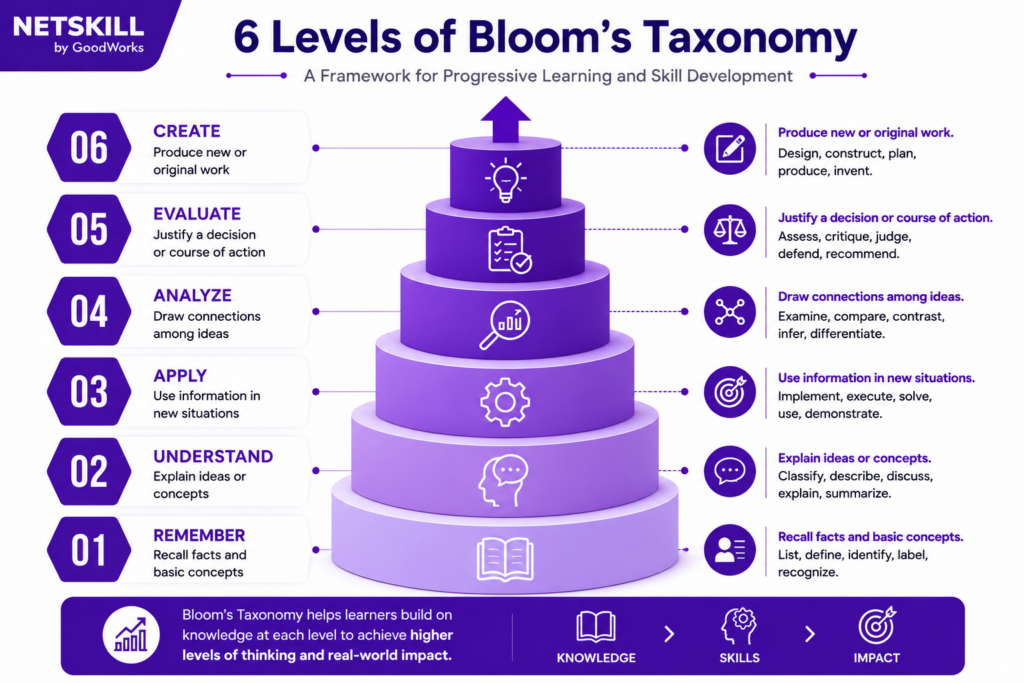
Bloom’s Taxonomy is a hierarchical framework that classifies learning objectives by cognitive complexity. Named after educational psychologist Benjamin Bloom, who developed the original framework with colleagues in 1956, it organises learning into six progressive levels from basic memorisation of facts at the base to the creative synthesis of entirely new ideas at the apex.
In 2001, Lorin Anderson and David Krathwohl published a revised version that made two critical changes: the six categories were rewritten as action verbs (not nouns), making learning objectives measurable, and Create replaced Evaluation at the top of the pyramid, recognising that generating new knowledge is the highest form of cognitive engagement.
The revised taxonomy is what modern L&D professionals use. It answers two questions every training designer must resolve before building a single slide:
What level of thinking does this job role actually require?
How do we design training that genuinely builds up to that level?
Quick stat: According to LinkedIn’s 2024 Workplace Learning Report, 94% of employees say they would stay at a company longer if it invested in their learning and development. Bloom’s Taxonomy is the structural foundation that makes that investment return measurable results.
The Three Domains
What Most Guides Miss
Here is the gap almost every competitor blog glosses over: Bloom’s Taxonomy does not just cover cognitive skills. It actually spans three distinct learning domains. Designing with all three in mind is what separates training that produces real behavioural change from training that simply creates awareness.
Cognitive Domain
Thinking skills. The six levels most people know from Remember to Create. Core to onboarding, technical training, compliance, and leadership development.
Affective Domain
Attitudes and values. Five levels from Receiving to Characterising. Essential for DEI programmes, ethical leadership, and culture change initiatives.
Psychomotor Domain
Physical and kinesthetic skills. Critical for manufacturing, healthcare, retail, and any hands-on technical role where doing is the evidence of learning.
Why this matters: DEI training, culture transformation, and ethical leadership programmes that only address cognitive knowledge almost always fail to produce lasting behavioural change. The affective domain must be explicitly designed in not assumed.
The 6 Levels of Bloom’s Taxonomy, Explained
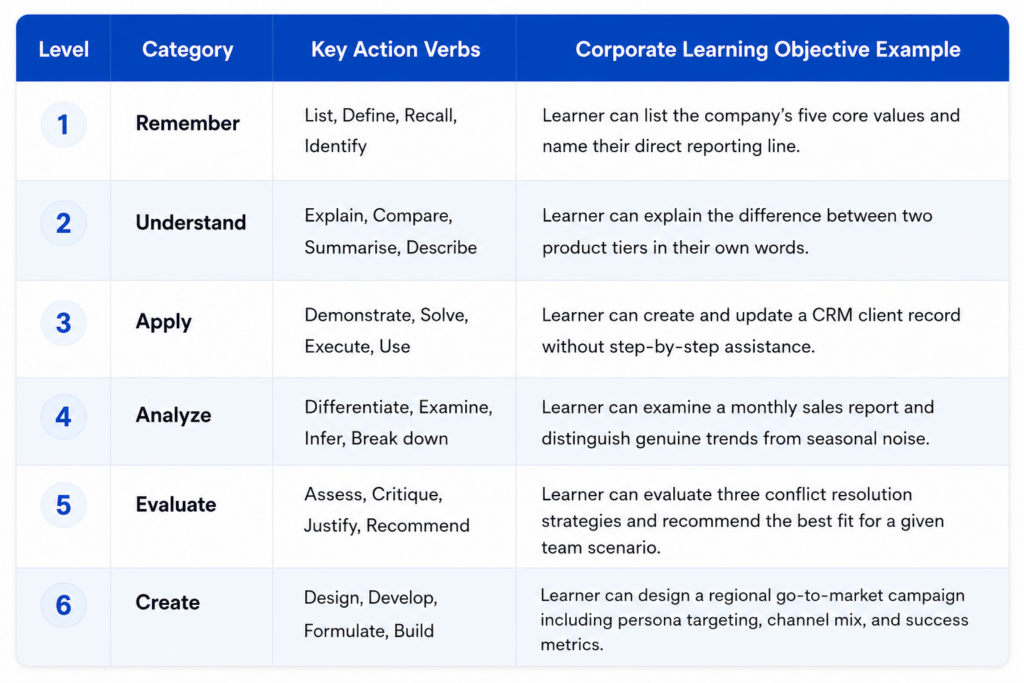
The cognitive domain’s six levels are the practical core of Bloom’s Taxonomy for L&D professionals. Each level builds on the previous one, and each demands a fundamentally different type of training activity and assessment method.
Higher-order vs. lower-order thinking: Levels 1–3 are lower-order thinking skills (LOTS). Levels 4–6 are higher-order thinking skills (HOTS). The majority of corporate training programmes stop at Level 3 which is why employees can pass tests but struggle to perform under real-world pressure.
Want to map your training to the right Bloom’s level?
Netskill’s AI platform auto-aligns your learning objectives and tracks cognitive progression in real time.
How to Write Learning Objectives Using Bloom’s Taxonomy
The most practical application of Bloom’s Taxonomy is writing sharp, measurable learning objectives. Vague objectives like “understand data security” are impossible to assess and give course designers no guidance on what to build. Bloom’s-anchored objectives solve this entirely.
Use this three-part formula for every objective you write:
The Formula: “By the end of [module/programme], the learner will be able to [Bloom’s action verb] [specific knowledge or skill] [to what standard or under what conditions].”
Weak: “Understand customer objection handling.” Strong: “By the end of this module, the learner will be able to apply the LAER framework (Listen, Acknowledge, Explore, Respond) to resolve three common objections in a live role-play scenario.”
Notice how the strong version locks in a Bloom’s level (Apply), specifies the framework being used, and defines the assessment condition (live role-play). This gives instructional designers a clear brief and gives learners a clear expectation of what mastery looks like.
4 Mistakes L&D Teams Make with Bloom’s Taxonomy
1. Stopping at Understand. Designing programmes that end at Level 2 produces employees who are informed but not capable. Every programme should have at least one activity that pushes learners into the Apply level where knowledge becomes a skill.
2. Using vague learning objectives. “Understand data security” is not a learning objective it is a vague intention. Always anchor objectives to a specific Bloom’s action verb that makes the outcome observable and measurable.
3. Mismatching assessments to levels. Multiple-choice quizzes accurately measure Remember and Understand nothing higher. Simulations, case studies, and scenario-based assessments are required for Apply, Analyze, and Evaluate. Using the wrong assessment tool produces misleading data about learner readiness.
4. Applying one level to every role. A customer service representative may only need to reach Apply. A product manager needs to operate at Evaluate and Create. Setting the same cognitive ceiling for every role wastes training time and underserves your highest performers.
How to Implement Bloom’s Taxonomy: A 5-Step Roadmap
1. Map job tasks to Bloom’s levels. Before writing a single objective, identify what cognitive level each job task genuinely demands. A compliance task might only need Remember and Apply. A strategic role needs Evaluate and Create. This task analysis is your design ceiling.
2. Write action-verb learning objectives. Use the three-part formula for every objective: Bloom’s verb + specific skill + assessment condition. Avoid passive, unmeasurable language entirely.
3. Choose activities that match the target level. Video and structured reading for Remember/Understand. Simulations and role-plays for Apply. Case studies and debate for Analyze/Evaluate. Capstone projects and design challenges for Create. The activity type is not cosmetic — it is what drives cognitive engagement.
4. Align assessments to the cognitive level. Every assessment must match the Bloom’s level being targeted. Assess Apply-level skills with simulation or observed performance, not a quiz. Assess Evaluate-level skills with written critique or structured scenario work, not a matching exercise.
5. Connect outcomes to business KPIs. Map each learning objective to the business metric it is designed to move conversion rates for sales training, error rates for compliance, engagement scores for leadership programmes. This is what transforms L&D from a budget line to a business driver.
Bloom’s Taxonomy in Modern eLearning and AI-Powered Training
Bloom’s Taxonomy is not a relic of classroom-based education it is the essential quality filter for digital and AI-powered learning environments.
In eLearning, the taxonomy guides content structure: explainer videos and knowledge checks serve Remember and Understand, while branching scenarios and interactive simulations are essential for Apply and Analyze. Adaptive learning platforms can automatically surface content at the right cognitive level based on individual learner performance, making personalised progression scalable.
In microlearning (3–10 minute focused modules), individual pieces typically target Remember or Understand. But a well-sequenced microlearning campaign can scaffold all six Bloom’s levels across a series from concept introduction to real-world application challenge without overwhelming learners.
In AI-powered training, Bloom’s Taxonomy becomes a prompt and evaluation standard. When generating assessment questions, specifying the target Bloom’s level (“generate five Analyze-level questions about the Q3 sales data”) produces dramatically more useful output than unstructured prompts. AI-driven roleplay and coaching simulations are also emerging as powerful tools for Apply and Evaluate-level training at scale providing personalised practice environments that were previously only available in live facilitated sessions.
Netskill advantage: Netskill’s AI-powered platform lets L&D teams map course content directly to Bloom’s Taxonomy levels, tag objectives automatically, and track each learner’s progression through the cognitive hierarchy so you always know exactly where individuals and teams are getting stuck.
Conclusion
Bloom’s Taxonomy has endured for nearly 70 years because it captures something fundamental about how human beings learn: genuine competence is built progressively, level by level, and the kind of thinking a job requires should determine how training is designed — not the other way around.
The most effective L&D teams use Bloom’s Taxonomy as a live design tool, not a theoretical checklist. Every learning objective, every activity choice, every assessment method, and every KPI connection should trace back to the cognitive level that actually matters for performance in that role.
Start with a single programme. Map the job tasks. Define the right cognitive ceiling. Write objectives with action verbs. Build assessments that match. Measure business impact. That cycle — repeated across your learning portfolio is how you move from reactive training events to a proactive, high-performance learning culture.
Ready to Level Up Your L&D?
Design Training That Actually Builds Skills
Netskill’s AI-powered platform helps L&D teams map programmes to Bloom’s Taxonomy, write sharper objectives, and measure real workforce capability gains.
NetSkill Enterprise Learning Ecosystem (LMS, LXP, Frontline Training, and Corporate Training) is the state-of-the-art talent upskilling & frontline training solution for SMEs to Fortune 500 companies.
DISCOVER HOW GEN-AI IS TRANSFORMING HR OPERATIONS.
Join NetSkill’s exclusive live session on “How to Use Generative AI in HRA”, where we’ll dive into real-world use cases, automation strategies, and implementation frameworks tailored for HR leaders.
Date: 29th SEP, 2026
Time: 4:00 PM IST
Online via Google Meet
Whether you're a CHRO, HRBP, or L&D leader, this session will give you a competitive edge in adopting AI for talent management, recruitment, onboarding, and more.