NetSkill Wins Google For Startups Grant Of $350k!
Learn More >No. 1 Corporate Training & Upskilling Company in the World.
Talk to usWhy Power Skills Will Define Workforce Success in 2026 and Beyond
The future of work is no longer driven by technical expertise alone. As artificial intelligence, automation, and digital tools reshape roles across industries, power skills, the human capabilities that enable people to think, lead, adapt, and collaborate, have emerged as the most critical drivers of performance.
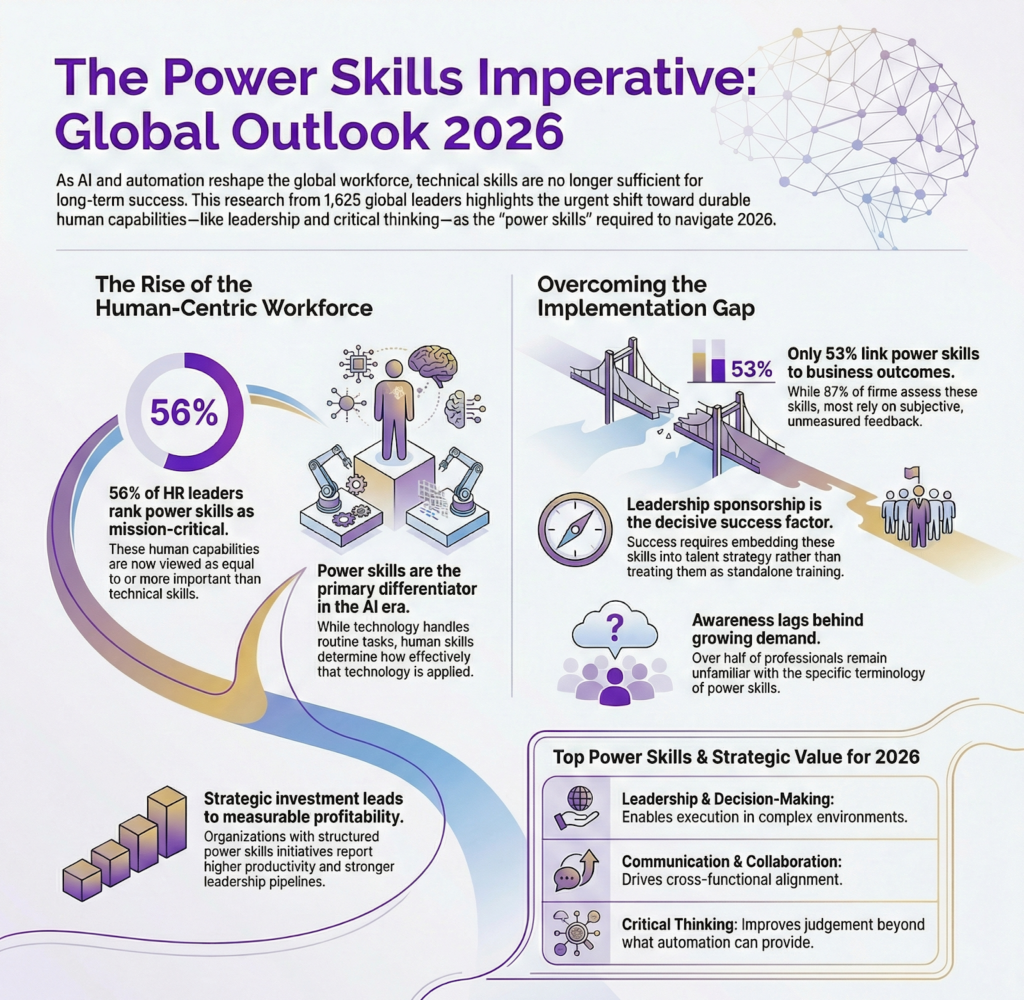
The Power Skills Imperative: Global Outlook 2026, a large-scale global research study by upGrad Enterprise, captures insights from 1,625 HR and L&D leaders across India, the United States, the United Kingdom, and Europe, revealing how organisations are redefining talent, productivity, and growth in the AI era.
What Are Power Skills?
Power skills refer to the essential human capabilities that enable individuals and teams to perform effectively in complex and rapidly changing work environments. These include:
- Leadership and decision-making
- Communication and collaboration
- Critical thinking and problem-solving
- Adaptability and resilience
- Emotional intelligence and people management
Unlike technical skills that evolve rapidly with technology, power skills remain transferable, durable, and foundational, making them indispensable for long-term organisational success.
Why Power Skills Matter More Than Ever in 2026
The research highlights a clear shift in how organisations define capability and performance:
1. Power Skills Are Now Mission-Critical
More than 56% of HR leaders globally identify power skills as essential to role success—on par with, or even exceeding, technical competencies in many functions.
In an AI-enabled workplace, power skills determine how effectively employees:
- Apply technology to real business problems
- Make decisions under uncertainty
- Lead teams through change
2. Awareness Gaps Are Slowing Adoption
While power skills are widely valued, over half of professionals are unfamiliar with the term itself. This disconnect between terminology and practice often results in:
- Underinvestment in structured training
- Inconsistent evaluation
- Limited visibility at the leadership level
The insight is clear: organisations value power skills but struggle to formalise them.
3. Power Skills Drive Measurable Business Impact
Organisations that systematically invest in power skills development report:
- Improved productivity
- Stronger leadership pipelines
- Higher employee engagement
- Tangible profitability gains
In high-growth markets such as India, structured power skills initiatives are already demonstrating a direct link between people capability and financial performance.
4. Measurement Remains a Critical Challenge
Although 87% of organisations assess power skills, most rely on subjective methods such as manager feedback or self-assessments.
Only 53% directly link power skills development to business outcomes, creating a gap between learning investment and strategic decision-making.
Without measurable frameworks, power skills risk being treated as “soft” priorities rather than performance drivers.
5. Leadership Buy-In Determines Success
The research underscores one decisive factor: senior leadership sponsorship.
Organisations that embed power skills into:
- Talent strategy
- Performance management
- Leadership development
are significantly more likely to achieve scalable, long-term impact compared to those treating power skills as standalone training initiatives.
Top 5 Findings from the Field
- Power Skills Drive Real-World Performance
Power skills have moved from “nice-to-have” to business-critical. Organisations report that capabilities like leadership, communication, adaptability, and critical thinking now directly influence productivity, decision-making, and team effectiveness. - Skill Awareness Lags Behind Skill Importance
While employers value power skills, many professionals are unfamiliar with the terminology. This gap slows structured adoption and highlights the need for clearer frameworks and communication from HR and L&D leaders. - Measurement Remains Inconsistent
Most organisations assess power skills informally through manager feedback, but fewer link them to measurable business outcomes, limiting scalability and strategic impact. - Leadership Sponsorship Accelerates Success
Companies with active senior leadership involvement see stronger alignment between power skills development and organisational goals. - Power Skills Deliver Competitive Advantage
Organisations investing systematically in power skills report higher engagement, stronger leadership pipelines, and improved business performance.
Inside the Report, You’ll Find
- Insights from 1,625 HR and L&D leaders across global markets
- Data-backed analysis of emerging power skills trends through 2026
- Regional comparisons highlighting differences in adoption and impact
- Practical guidance for building scalable power skills strategies
- Clear links between workforce capability and business outcomes
Power Skills Are Now Central to How Work Gets Done
Power skills have become the foundation of modern work. As automation and AI take over routine tasks, human capabilities determine how effectively technology is applied to real-world challenges.
From leading distributed teams to navigating uncertainty and making complex decisions, power skills now define how results are delivered, how teams collaborate, and how organisations stay competitive in a rapidly changing business environment.
The Most In-Demand Power Skills for 2026
Based on global employer demand and workforce trends, the study identifies the following as the most critical power skills:
| Power Skill | Strategic Value |
| Leadership & Decision-Making | Enables execution in complex environments |
| Communication & Collaboration | Drives cross-functional alignment |
| Adaptability & Resilience | Supports change and uncertainty |
| Critical Thinking | Improves judgement beyond automation |
| Emotional Intelligence | Strengthens trust and team performance |
These skills are increasingly viewed as non-negotiable for leadership and high-impact roles.
From Intent to Impact: Building a Power Skills Ecosystem
The report highlights that successful organisations move beyond ad-hoc training by:
- Embedding power skills into role frameworks
- Aligning learning outcomes with business KPIs
- Leveraging data-driven assessment models
- Integrating learning into daily workflows
This ecosystem approach transforms power skills from abstract concepts into operational capabilities.
The Strategic Implications for HR and L&D Leaders
For organisations preparing for 2026, the message is clear:
- Power skills are no longer optional
- AI amplifies, not replaces, human capability
- Measurement and leadership ownership are essential
- Workforce strategy must balance technical and human skills
Those who act now will build resilient, future-ready teams. Those who delay risk widening capability gaps in an increasingly competitive talent landscape.
Power Skills Are the Competitive Advantage of the Future
As technology continues to redefine how work is done, power skills will define how well it is done.The Power Skills Imperative: Global Outlook 2026 establishes a clear roadmap for organisations seeking sustainable growth, placing human capability at the centre of business performance.




NetSkill Enterprise Learning Ecosystem (LMS, LXP, Frontline Training, and Corporate Training) is the state-of-the-art talent upskilling & frontline training solution for SMEs to Fortune 500 companies.