NetSkill Wins Google For Startups Grant Of $350k!
Learn More >Enterprise training works best when digital learning and instructor-led training are not treated as separate programs. A blended learning model powered by an AI-powered learning experience platform helps companies combine self-paced learning, live sessions, coaching, assessments, and analytics into one connected learning journey.
For large organizations, this matters because training is no longer limited to classroom calendars or static LMS modules. Employees need flexible learning, managers need measurable outcomes, and L&D teams need systems that can scale without losing personalization. That is where an LXP platform for corporate training creates real value.
Blended learning with an LXP gives businesses the structure of formal training and the flexibility of digital learning. It helps employees prepare before live sessions, apply concepts during workshops, and continue learning after the trainer leaves. For enterprises managing distributed teams, frontline employees, GCC teams, sales teams, or leadership programs, this model is becoming one of the most practical ways to improve learning outcomes.
What Is Blended Learning with an AI-Powered Learning Experience Platform?
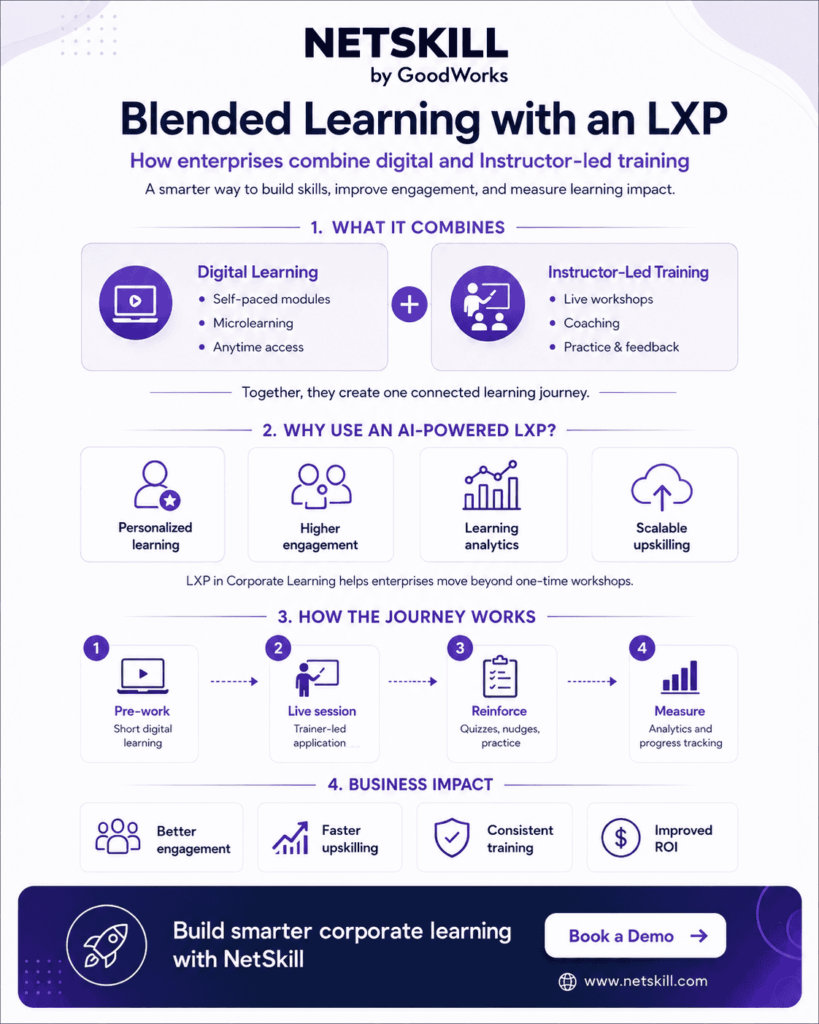
Blended learning with an AI-powered learning experience platform combines digital learning content with live instructor-led training in one structured learning journey. Instead of choosing between online learning and classroom training, enterprises use both formats where each one delivers the most value.
Digital learning is useful for concepts, pre-work, microlearning, compliance modules, assessments, and reinforcement. Instructor-led training works better for discussion, role-play, coaching, problem-solving, leadership behavior, sales practice, and complex decision-making. When both are connected through a corporate learning experience platform, the learner does not experience training as separate activities. They experience it as one guided path.
For example, a manager may complete short digital modules before attending a leadership workshop. During the live session, the trainer focuses on application instead of theory. After the session, the LXP recommends follow-up content, quizzes, coaching prompts, and manager check-ins. This creates continuity, which is often missing in traditional Corporate Training solutions.
Why Is LXP in Corporate Learning Important for Blended Training?
LXP in Corporate Learning is important because it turns blended training from a one-time event into a continuous learning experience. It connects content, live sessions, assessments, learner data, recommendations, and performance insights in one system.
Traditional training often fails because the learning journey is fragmented. Employees attend a workshop, receive slides, complete feedback forms, and then return to work with little reinforcement. An AI-powered learning experience platform solves this by supporting the full learning cycle before, during, and after the instructor-led session.
The LXP can assign pre-session learning, track completion, personalize content, host recordings, recommend next steps, and measure progress. L&D teams can see who completed pre-work, who needs support, which content worked, and whether learning is translating into skill growth. This makes blended learning easier to manage at enterprise scale. More importantly, it gives business leaders visibility into training impact instead of relying only on attendance numbers.
How Does a Corporate Learning Experience Platform Support Instructor-Led Training?
A corporate learning experience platform supports instructor-led training by making live sessions more focused, data-driven, and outcome-oriented. It helps trainers understand learner readiness before the session and gives employees structured reinforcement after the session.
Before the training, the platform can assign diagnostic assessments, short videos, reading material, or simulations. This gives the trainer a clearer view of the group’s current knowledge level. Instead of spending the first hour explaining basics, the instructor can focus on discussion, practice, and role-based application.
During the session, the LXP can support polls, quizzes, attendance tracking, activity submissions, breakout assignments, and resource sharing. After the session, it can recommend learning paths based on learner performance. For example, employees who struggled with a concept can receive additional microlearning modules, while advanced learners can move to higher-level content.
This makes instructor-led training more valuable because the session becomes part of a larger learning system, not a standalone classroom event.
What Are the Business Benefits of an LXP Platform for Corporate Training?
An LXP platform for corporate training improves learning engagement, training consistency, personalization, and measurement. It helps enterprises deliver structured learning while still adapting to different roles, skill levels, locations, and business goals.
The first benefit is consistency. Large organizations often struggle when different trainers, departments, or locations deliver training differently. An AI-powered learning experience platform standardizes the core learning journey while still allowing trainers to customize live delivery for specific teams.
The second benefit is personalization. Employees do not all need the same content at the same pace. An LXP can recommend learning based on role, department, assessment performance, skill gaps, and career goals. This is especially useful for employee upskilling and reskilling.
The third benefit is measurement. L&D teams can move beyond attendance and satisfaction scores. They can track completion, assessment scores, engagement patterns, learning paths, content usage, skill growth, and follow-up behavior. That gives leadership a clearer view of training ROI.
How Can Enterprises Design a Blended Learning Journey Using an LXP?
Enterprises can design a blended learning journey by mapping each learning objective to the right format: digital content, live instruction, practice, assessment, or reinforcement. The goal is not to add more content, but to design a smarter learning flow.
A strong blended learning journey usually starts with a business problem. For example, a company may need to improve sales conversion, reduce compliance errors, strengthen manager capability, or speed up onboarding. Once the business goal is clear, the L&D team can break it into skills, behaviors, and knowledge areas.
The LXP can then support the journey in stages. Pre-work builds baseline knowledge. Instructor-led sessions help employees apply learning. Assessments validate understanding. Microlearning reinforces key points. Learning analytics show where learners are progressing or dropping off. Manager nudges help convert learning into workplace action.
This structure works because every activity has a clear role. Digital learning prepares and reinforces. Instructor-led training deepens and applies.
What Should Digital Learning Cover Before Instructor-Led Training?
Digital learning before instructor-led training should cover foundational knowledge, definitions, process basics, product context, policies, and simple scenarios. This allows the live session to focus on deeper application instead of basic explanation.
In many corporate training programs, instructors spend too much time covering information that employees could have learned independently. This reduces the value of the live session. With an AI-powered learning experience platform, employees can complete short modules before the session so everyone starts with a shared baseline.
For example, in a sales training program, digital pre-work can cover product knowledge, buyer personas, pricing basics, and objection categories. The live instructor-led session can then focus on role-plays, call reviews, negotiation practice, and coaching. In compliance training, digital learning can cover policy rules, while live sessions can handle real business scenarios and ethical decision-making.
This approach respects the trainer’s time and improves learner readiness.
What Should Instructor-Led Training Cover in a Blended Learning Model?
Instructor-led training should focus on interaction, practice, problem-solving, feedback, and behavior change. These are the areas where human trainers create the strongest value compared with self-paced digital content.
A good blended learning design does not use trainers to repeat what employees already watched in digital modules. It uses trainers to help learners make sense of the material, ask questions, work through scenarios, and practice skills in a safe environment. This is especially important for leadership development, communication skills, customer service, sales, compliance judgment, and technical problem-solving.
The instructor can use data from the LXP to personalize the session. If pre-assessment scores show that learners already understand basic concepts but struggle with application, the trainer can adjust the session accordingly. This makes instructor-led training more relevant and more efficient.
In short, digital learning builds knowledge. Instructor-led training builds confidence, judgment, and application.
How Does an AI-Powered Learning Experience Platform Improve Personalization?
An AI-powered learning experience platform improves personalization by recommending learning content based on role, skill level, learner behavior, assessment results, and career path. This helps employees receive training that is relevant to their work instead of generic content.
In a large enterprise, one-size-fits-all training creates two problems. Some employees feel the content is too basic, while others feel it is too advanced. Both groups disengage. AI-powered recommendations can solve this by guiding learners toward the right next step.
For example, a new manager may receive modules on feedback conversations, team motivation, and performance reviews. A senior manager may receive content on strategic decision-making, coaching leaders, and business alignment. A frontline employee may receive mobile-first microlearning, while a corporate employee may receive scenario-based learning paths.
This makes LXP in Corporate Learning more effective because the platform adapts the learning experience to the learner, not the other way around.
How Can Learning Analytics Prove Training ROI?
Learning analytics prove training ROI by connecting learning activity with measurable indicators such as completion, assessment scores, skill progress, engagement, behavior change, and business outcomes. Without analytics, blended learning becomes difficult to justify at scale.
A corporate learning experience platform gives L&D teams visibility into what is working and what is not. They can see which modules are completed, which sessions drive higher assessment scores, which learners need support, and where content may need improvement. Over time, this creates a stronger evidence base for training decisions.
For example, a customer support training program can track product knowledge scores, scenario performance, and post-training ticket resolution quality. A sales training program can track certification completion, role-play scores, and improvement in sales conversations. A compliance training program can track completion, assessment accuracy, and policy understanding.
This allows Corporate Training solutions to move from activity reporting to business impact reporting.
What Are Common Mistakes Enterprises Make with Blended Learning?
The most common mistake is treating blended learning as simply adding online modules before a classroom session. True blended learning requires intentional design, clear sequencing, trainer alignment, learner support, and post-training reinforcement.
Another mistake is overloading employees with too much content. Digital learning should not become a dumping ground for every document, video, and policy file. Learners need curated pathways, not endless libraries. An LXP platform for corporate training should guide employees through what matters most.
A third mistake is not training instructors to use platform data. If trainers ignore learner analytics, they miss the chance to tailor live sessions. A fourth mistake is measuring only attendance. Attendance tells you who showed up. It does not tell you who learned, applied, or improved.
The strongest blended learning programs are designed around outcomes first, delivery formats second.
How Can Enterprises Choose the Right LXP Platform for Corporate Training?
Enterprises should choose an LXP platform for corporate training by evaluating personalization, blended learning support, analytics, integrations, mobile access, content management, and ease of administration. The right platform should support both learner experience and L&D operations.
A strong AI-powered learning experience platform should allow teams to create structured learning paths, assign pre-work, manage instructor-led sessions, track progress, host assessments, recommend content, and generate actionable reports. It should also integrate with HRMS, LMS, video tools, content libraries, collaboration tools, and reporting systems.
The platform should be simple for learners and powerful for administrators. If employees find it difficult to access learning, engagement will drop. If L&D teams struggle to manage content and reports, adoption will suffer.
Enterprises should also check whether the platform supports multiple audiences such as employees, managers, frontline workers, partners, and customers. Scalability matters when training needs grow across regions, teams, and roles.
Why Should Enterprises Use Blended Learning for Employee Upskilling?
Enterprises should use blended learning for employee upskilling because it combines flexibility, structure, and human guidance. Employees can learn at their own pace, but still receive instructor support where deeper skill development is needed.
Upskilling is not just about completing courses. Employees need to build confidence, practice new skills, receive feedback, and apply learning in real work situations. Digital learning alone can create awareness, but instructor-led training helps convert knowledge into capability.
For example, AI literacy training may begin with self-paced modules on AI concepts, responsible use, and tool basics. Live sessions can then help employees apply AI to their specific workflows. Follow-up modules can reinforce best practices, while assessments can validate readiness.
This is where LXP in Corporate Learning becomes valuable. It gives enterprises one system to guide, track, personalize, and improve upskilling programs across the workforce.
Ready to Build a Smarter Blended Learning Strategy?
If your corporate training still runs as scattered workshops, static LMS modules, and manual tracking sheets, it may be time to rethink the learning experience. An AI-powered learning experience platform can help your enterprise combine digital learning, instructor-led training, assessments, analytics, and personalized learning paths into one connected system.
Speak to NetSkill to design a blended learning roadmap for your workforce.
Explore how an LXP platform for corporate training can improve employee engagement, skill development, and training ROI.


NetSkill Enterprise Learning Ecosystem (LMS, LXP, Frontline Training, and Corporate Training) is the state-of-the-art talent upskilling & frontline training solution for SMEs to Fortune 500 companies.