NetSkill Wins Google For Startups Grant Of $350k!
Learn More >No. 1 Corporate Training & Upskilling Company in the World.
Talk to usWorkshop-based corporate training still matters because some workplace skills are learned best through interaction, practice, feedback, and real-time correction. Online learning is useful for scale, but workshops create the human environment needed for behaviour change, collaboration, and applied learning.
This is especially true for leadership, communication, sales, customer service, workplace ethics, team collaboration, conflict management, safety, compliance, and role-based technical training. Employees may watch a course online, but that does not always mean they can apply the skill at work. Workshops close this gap by turning passive learning into guided practice. For companies evaluating a corporate training company in India, the smarter question is not online versus offline. The real question is which learning format creates measurable performance improvement for the team.
Build a Practical Training Plan
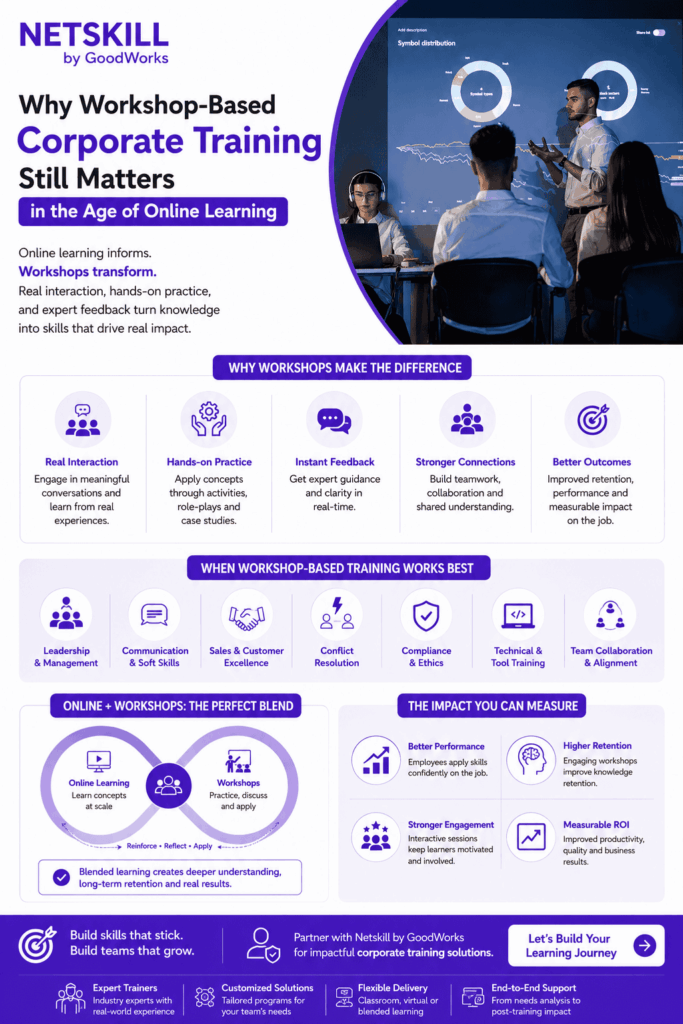
What makes workshop-based corporate training different from online learning?
Workshop-based corporate training is different because it creates live interaction, immediate feedback, peer discussion, and practical application. Online learning delivers content efficiently, but workshops help employees practise skills in real workplace situations.
In a workshop, employees can ask questions, discuss challenges, role-play scenarios, solve problems, and receive facilitator guidance. This matters because workplace learning is rarely just information transfer. A manager learning delegation needs to practise difficult conversations. A sales team learning negotiation needs live objection handling. A customer service team learning empathy needs situational practice. These experiences are harder to replicate through self-paced modules alone. Good corporate training solutions use workshops when the learning outcome requires participation, behaviour change, or team alignment. Online learning works well for awareness; workshops work better when performance needs to change.
Why do companies still invest in corporate training services?
Companies still invest in corporate training services because business performance depends on how well employees apply skills on the job. Training helps reduce skill gaps, improve productivity, strengthen leadership, and prepare teams for changing workplace demands.
In 2026, companies are dealing with AI adoption, hybrid work, digital transformation, customer expectations, compliance pressure, and faster business cycles. Employees need more than basic knowledge. They need judgement, communication, adaptability, teamwork, and problem-solving ability. Corporate training services help organizations design structured learning programs around these needs. A good training partner does not just deliver sessions. It helps identify skill gaps, customize content, assign experienced trainers, measure outcomes, and recommend follow-up learning. This makes training more connected to business goals instead of becoming a one-time HR activity.
When is workshop-based training better than self-paced learning?
Workshop-based training is better when the skill requires practice, discussion, feedback, or behavioural change. Self-paced learning works well for knowledge transfer, but workshops are stronger for skills that employees must demonstrate in real situations.
For example, communication skills, leadership, emotional intelligence, POSH awareness, workplace ethics, customer handling, negotiation, presentation skills, and team management benefit from live facilitation. Participants learn by practising, making mistakes, observing peers, and receiving feedback. Technical workshops also matter when employees need guided labs, hands-on problem solving, or tool-based practice. Self-paced learning may explain a concept, but it cannot always correct poor application. This is why many companies use blended learning. Employees complete digital modules for foundational knowledge and attend workshops for practical application. The combination improves both scale and impact.
How do corporate training solutions support behaviour change?
Corporate training solutions support behaviour change by creating structured learning journeys, not just one-time sessions. Behaviour change requires awareness, practice, feedback, reinforcement, and workplace application.
A well-designed workshop begins with clear objectives. It then introduces concepts, connects them to job roles, creates practice scenarios, and gives participants feedback. After the workshop, companies can reinforce learning through assignments, manager check-ins, assessments, refresher modules, and peer discussions. This structure is important because employees rarely change behaviour after one lecture. They change when learning is repeated, relevant, and supported by their managers. Effective corporate training solutions are designed around this reality. They focus on what employees should do differently after the training, not only what they should know during the session.
Why is corporate training in bangalore growing across industries?
Corporate training in bangalore is growing because the city has a strong concentration of technology companies, startups, GCCs, IT services firms, product companies, and enterprise teams. These organizations need continuous upskilling to stay competitive.
Bangalore-based companies often work in fast-changing environments where employees need technical, managerial, communication, and leadership capabilities. Teams may need training on AI tools, cloud platforms, project management, customer communication, sales effectiveness, workplace ethics, cybersecurity, or agile delivery. The city’s workforce is also highly diverse, with employees from different regions, cultures, and professional backgrounds. This creates a strong need for structured learning experiences that build alignment. For companies looking for corporate training in bangalore, workshop-based formats are still valuable because they bring teams together, encourage discussion, and create shared understanding across functions.
What should a corporate training company in India offer beyond sessions?
A corporate training company in India should offer training needs analysis, customized content, qualified trainers, role-based delivery, assessments, learning reports, and post-training reinforcement. Training should not stop at conducting a session.
The best training partners begin by understanding the business problem. Is the company trying to improve communication? Reduce workplace conflict? Build first-time managers? Improve sales performance? Train employees on new software? Strengthen compliance? Once the need is clear, the training should be customized for the audience. A frontline team, manager group, technical team, and leadership team cannot receive the same content in the same way. A strong partner also measures outcomes through feedback, assessments, participation, manager inputs, and follow-up support. This is what separates serious corporate training services from generic classroom programs.
How do workshops improve engagement compared to online-only learning?
Workshops improve engagement because employees participate actively instead of only consuming content. Live discussions, group activities, case studies, simulations, and facilitator questions make learning more memorable and relevant.
Online learning often struggles when employees multitask, skip modules, or complete courses only for compliance. Workshops reduce this problem by creating accountability and social learning. Participants hear real examples from peers, discuss workplace challenges, and apply concepts immediately. This is especially useful for topics where personal experience matters, such as leadership, conflict resolution, communication, and customer service. Good facilitators also read the room and adjust examples based on participant responses. This flexibility is difficult in purely self-paced learning. For high-impact training, engagement is not a nice-to-have. It is the bridge between content and application.
Can online learning and workshops work together?
Yes, online learning and workshops work best when they are combined into a blended learning journey. Online modules can cover concepts before or after the workshop, while live sessions focus on practice, discussion, and application.
This approach gives companies both scale and depth. Employees can complete short digital lessons before the session, so everyone arrives with a common foundation. The workshop can then focus on case studies, role-plays, problem solving, and business-specific scenarios. After the session, learners can receive microlearning modules, quizzes, assignments, or refresher content to reinforce the behaviour. Blended corporate training solutions are especially useful for large organizations because they allow consistent knowledge delivery without losing the human element. The goal is not to choose one format permanently. The goal is to use each format where it works best.
Which topics are best suited for workshop-based corporate training services?
Workshop-based corporate training services are best suited for topics that require interaction, practice, judgement, or team alignment. These include leadership, communication, customer service, sales, workplace ethics, POSH, conflict management, negotiation, and managerial effectiveness.
Technical topics can also work well in workshop format when they require hands-on labs or guided application. Examples include Excel, Power BI, cloud tools, cybersecurity awareness, project management platforms, AI tools, CRM systems, and enterprise software adoption. Workshops are also useful when companies want employees to solve internal problems together. For example, a team can use a workshop to improve service desk workflows, customer escalation handling, cross-functional collaboration, or project communication. The best topics are not chosen because they sound popular. They are chosen because they solve a real business or performance problem.
How should companies measure workshop training impact?
Companies should measure workshop training impact through learning outcomes, participant engagement, skill application, manager feedback, and business indicators. Attendance alone is not a reliable measure of training success.
A good measurement plan begins before the training. Define what should improve after the workshop. Is it communication clarity? Faster customer response? Better manager feedback? Fewer compliance issues? Higher tool adoption? Then use pre-assessments, post-assessments, participant feedback, practical exercises, and follow-up manager inputs. For some programs, business metrics can also be tracked, such as sales conversion, support quality, productivity, retention, or error reduction. A corporate training company in India should help clients define these measures clearly. Training becomes more valuable when companies can connect learning to workplace performance.
How should companies choose the right corporate training partner?
Companies should choose a corporate training partner based on customization, trainer quality, delivery flexibility, domain understanding, and measurement capability. The right partner should understand the business problem before recommending a workshop.
Ask whether the provider can conduct a training needs analysis, customize the module, share trainer profiles, align examples to your industry, and provide post-session reports. Also check whether they can deliver different formats such as onsite workshops, virtual instructor-led sessions, blended learning, and short refresher programs. If the requirement is corporate training in bangalore, check whether the partner can support local delivery with experienced trainers and flexible scheduling. The right partner will not push a standard catalog blindly. They will ask what outcome the company wants and then design the learning experience around that outcome.
Why does NetSkill fit modern corporate training needs?
NetSkill fits modern corporate training needs because it combines structured corporate training services with technology-enabled learning support. This helps companies deliver workshops, digital learning, assessments, and reinforcement in a more organized way.
For organizations that want practical workplace learning, NetSkill can support instructor-led workshops across behavioural, leadership, compliance, productivity, and technical topics. For companies that need scale, it can also support digital learning through LMS/LXP capabilities, assessments, analytics, learning paths, mobile access, and blended learning journeys. This matters because modern training cannot depend only on a one-day session. Employees need learning before, during, and after the workshop. NetSkill helps companies move from isolated training events to more continuous learning experiences that are easier to manage, track, and improve.
Speak to NetSkill About Corporate Training
Conclusion
Online learning has changed corporate training, but it has not replaced the need for workshops. Some skills still need human interaction, guided practice, feedback, and shared discussion.
The best learning strategy is not online-only or workshop-only. It is the right mix of both. Companies should use online learning for scale and workshops for depth. They should use digital modules for concepts and live sessions for application. That is how corporate training becomes practical, measurable, and business-aligned.
For companies looking for corporate training services, the goal should be clear: build learning experiences that employees can apply at work. NetSkill helps organizations design workshop-based and blended corporate training solutions that improve skills, strengthen teams, and support long-term workforce development.
Build a Corporate Training Program with NetSkill
contact us @ hello@netskill.com | +91 7353948100


NetSkill Enterprise Learning Ecosystem (LMS, LXP, Frontline Training, and Corporate Training) is the state-of-the-art talent upskilling & frontline training solution for SMEs to Fortune 500 companies.