NetSkill Wins Google For Startups Grant Of $350k!
Learn More >Every growing business reaches a point where spreadsheets, scattered training content, and disconnected learning tools stop working. The question is no longer whether you need a learning platform it’s whether you need a Corporate LMS or an Enterprise LMS.
Although these terms are often used interchangeably, they solve very different business problems. A Corporate LMS focuses on delivering structured employee training, while an Enterprise LMS is built to support organizational growth, multiple business units, global teams, AI-driven learning, and enterprise-wide workforce development.
Choosing the wrong platform can limit scalability, create data silos, and increase administrative overhead as your organization expands. This guide explains the differences, compares their capabilities, and helps you determine which solution will support your business over the long term.
What Is an Enterprise LMS and Why Are Large Organizations Choosing It?
An Enterprise LMS is a learning platform designed to support large organizations with complex training requirements, multiple departments, distributed teams, compliance mandates, and advanced reporting. Unlike traditional systems, it centralizes learning while allowing every business unit to deliver personalized training experiences.
Modern enterprises use an Enterprise LMS because learning has evolved from course delivery into workforce capability building. HR leaders need visibility into skill gaps, managers need role-based learning paths, and executives need measurable business outcomes from training investments.
A modern Enterprise LMS typically includes AI-powered recommendations, competency mapping, certification management, multilingual learning, mobile accessibility, analytics dashboards, and integrations with HRMS, ERP, CRM, and collaboration platforms. Instead of managing multiple disconnected learning tools, organizations gain a single ecosystem capable of supporting employee onboarding, compliance, leadership development, customer education, and continuous upskilling across thousands of learners.
Ready to Build a Scalable Learning Ecosystem?
Whether you’re expanding across locations or preparing your workforce for future skills, NetSkill’s Enterprise LMS helps organizations deliver personalized, AI-driven learning at scale.
Schedule a Personalized Enterprise LMS Demo
What Is a Corporate LMS and When Is It the Right Choice?
A Corporate LMS is designed primarily to manage employee training within a single organization. It helps HR and Learning & Development teams deliver onboarding, compliance programs, mandatory certifications, and internal professional development through one centralized platform.
For many small and medium-sized businesses, a Corporate LMS provides all the essential capabilities required to manage learning efficiently. Employees can complete assigned courses, managers can monitor progress, and administrators can generate completion reports without significant technical complexity.
However, business requirements change as organizations grow. Multiple office locations, international teams, acquisitions, partner training, franchise networks, and diverse learning audiences often expose the limitations of traditional learning platforms. While Corporate LMS solutions remain valuable for internal learning, organizations planning rapid expansion frequently require greater flexibility, automation, integrations, and governance than these systems can provide.
Enterprise LMS vs Corporate LMS: What Are the Biggest Differences?
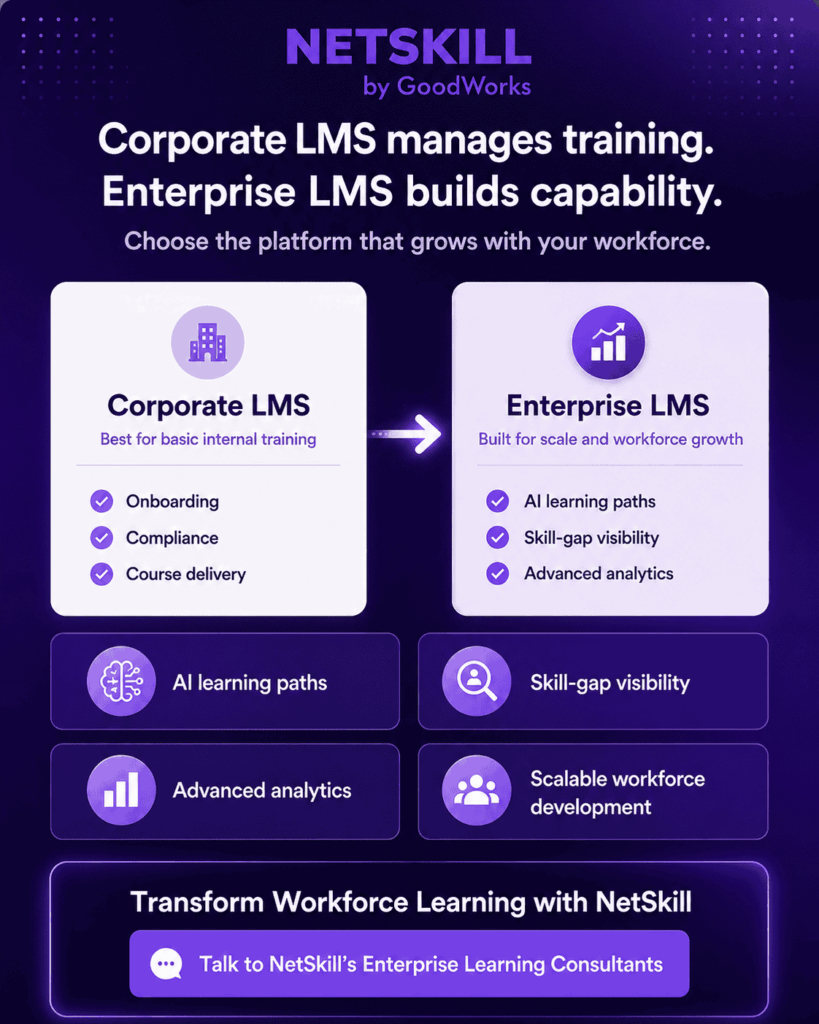
The primary difference between a Corporate LMS and an Enterprise LMS is scalability. A Corporate LMS focuses on managing employee learning, whereas an Enterprise LMS manages organizational capability across departments, regions, business units, and even external stakeholders.
An Enterprise LMS supports thousands of concurrent learners, role-based permissions, multilingual content, advanced reporting, API integrations, and enterprise security standards. It is built to handle complex organizational structures without compromising the learner experience.
Corporate LMS platforms generally emphasize simplicity and ease of administration, making them ideal for businesses with straightforward training needs. However, organizations experiencing rapid growth often require features such as multi-tenant architecture, advanced automation, AI-driven recommendations, and integration with HR systems to streamline workforce development. These capabilities enable enterprises to align learning directly with business objectives instead of simply delivering courses.
Which Platform Supports Business Growth More Effectively?
An Enterprise LMS supports business growth more effectively because it scales alongside the organization instead of becoming a bottleneck. As businesses expand into new markets, hire more employees, or introduce new business units, learning requirements become increasingly complex.
Growth requires more than additional training content. Organizations need centralized governance, localized learning experiences, automated compliance tracking, competency frameworks, and detailed workforce analytics. Enterprise platforms provide these capabilities while maintaining a consistent learner experience across the organization.
This scalability also reduces long-term technology costs. Instead of replacing learning systems every few years, organizations can continue building on the same platform as their workforce evolves. The result is greater operational efficiency, faster onboarding, improved employee readiness, and stronger alignment between learning initiatives and strategic business goals.
Why Is AI Becoming Essential in the Best AI-Powered LMS Platform?
Artificial intelligence is changing workplace learning from reactive training into proactive workforce development. The best AI-powered LMS platform doesn’t simply recommend courses it helps organizations understand future skill requirements before they become business challenges.
AI analyzes learner behavior, identifies competency gaps, recommends personalized learning paths, automates assessments, predicts certification renewals, and delivers actionable insights for HR leaders. Employees receive relevant learning experiences based on their roles, career aspirations, and performance instead of generic course assignments.
This creates higher engagement, better knowledge retention, and faster skill development across the workforce. As organizations embrace digital transformation, AI-enabled learning platforms are becoming strategic assets that improve both employee experience and organizational agility.
See How AI Can Transform Workforce Learning
Discover how NetSkill combines AI-driven recommendations, automated learning paths, skills intelligence, and enterprise analytics to create measurable business impact.
Book a Free AI LMS Walkthrough
How Does Corporate Training Platform Software Improve Business Performance?
The right corporate training platform software does more than deliver courses it directly impacts productivity, employee retention, compliance, and business agility. Organizations that connect learning with business objectives consistently outperform those that treat training as a one-time activity.
Modern businesses face constant change. New technologies, evolving customer expectations, and emerging regulations require employees to continuously develop new skills. A robust learning platform enables organizations to deliver targeted training quickly while tracking measurable outcomes.
For example, sales teams can receive product-specific learning before a new launch, customer support teams can complete updated compliance modules automatically, and managers can monitor team readiness through real-time dashboards. Instead of relying on manual spreadsheets or disconnected learning tools, decision-makers gain visibility into training completion, competency levels, certification status, and workforce readiness.
The result is a workforce that adapts faster, performs better, and contributes more effectively to organizational growth.
How Does an AI-Powered Learning Management System Create Better Learning Experiences?
An AI-powered learning management system personalizes learning for every employee by delivering the right content at the right time. Instead of assigning identical courses to every learner, AI analyzes roles, existing skills, learning behavior, assessment performance, and career goals to recommend individualized learning paths.
This personalized approach increases learner engagement because employees spend less time searching for relevant content and more time developing practical skills. AI can also automate repetitive administrative tasks such as assigning courses, sending certification reminders, recommending refresher training, and generating learning reports.
For HR and Learning & Development teams, this means reduced administrative effort and greater strategic value. Rather than managing spreadsheets and manual workflows, teams can focus on talent development, succession planning, and organizational capability building. As AI continues to evolve, learning platforms are becoming intelligent workforce development ecosystems rather than simple content repositories.
What Features Should You Look for in an Enterprise LMS?
Choosing an Enterprise LMS should start with your long-term business strategy rather than a checklist of features. The right platform should support today’s learning requirements while remaining flexible enough to accommodate future growth, technology adoption, and organizational change.
Some of the most important capabilities include:
- AI-powered personalized learning recommendations
- Skills and competency mapping
- Learning paths for different roles
- HRMS and ERP integrations
- Mobile-first learning experience
- Compliance and certification management
- Advanced analytics and executive dashboards
- Single Sign-On (SSO)
- Multi-language support
- Virtual instructor-led training
- Assessment and evaluation tools
- Content authoring capabilities
- Gamification and learner engagement features
- API integrations with enterprise applications
- Enterprise-grade security and role-based access controls
Beyond technology, evaluate implementation support, customer success, scalability, product roadmap, and vendor expertise. A learning platform is a long-term investment, and selecting a partner that understands enterprise learning can significantly improve adoption and business outcomes.
How Should Organizations Choose Between an Enterprise LMS and a Corporate LMS?
The right choice depends on where your organization is today and where it plans to be over the next five years. If your learning needs are limited to employee onboarding, mandatory compliance, and basic internal training, a Corporate LMS may provide everything you need.
However, organizations experiencing rapid hiring, expanding into multiple regions, managing distributed teams, or investing in digital transformation should consider an Enterprise LMS from the outset. Migrating learning platforms after significant growth can be costly, time-consuming, and disruptive.
Decision-makers should evaluate factors such as workforce size, integration requirements, reporting complexity, AI capabilities, compliance obligations, multilingual support, and future expansion plans. Looking beyond immediate requirements helps ensure the chosen platform continues delivering value as the business evolves.
Ultimately, the best learning platform is one that aligns employee development with business strategy, enabling organizations to build capabilities that support sustainable growth.
Enterprise LMS vs Corporate LMS: Which One Is the Better Investment?
A Corporate LMS and an Enterprise LMS both play important roles in workforce learning, but they serve different stages of organizational maturity. While a Corporate LMS is well-suited for structured internal training, an Enterprise LMS is designed to support long-term business growth, workforce transformation, and enterprise-wide learning strategies.
As organizations become more data-driven, learning is no longer measured by course completions alone. Success depends on how effectively employees acquire new skills, adapt to changing business needs, and contribute to organizational performance. Enterprise learning platforms enable this shift by combining AI, automation, analytics, and personalized learning into a unified ecosystem.
If your organization views learning as a strategic business function rather than an administrative process, investing in an Enterprise LMS today can create a stronger, more agile workforce for years to come.
Transform Workforce Learning with NetSkill
The right learning platform should do more than deliver content—it should help your organization build skills, improve performance, and prepare employees for future business challenges.
NetSkill’s Enterprise LMS is built for modern organizations that need AI-driven learning, enterprise-grade security, seamless integrations, advanced analytics, and scalable workforce development from a single platform.
Whether you’re onboarding new employees, managing compliance, delivering leadership programs, or building personalized learning journeys, NetSkill provides the tools to support every stage of employee growth.
Have Questions About Choosing the Right Learning Platform?

NetSkill Enterprise Learning Ecosystem (LMS, LXP, Frontline Training, and Corporate Training) is the state-of-the-art talent upskilling & frontline training solution for SMEs to Fortune 500 companies.