NetSkill Wins Google For Startups Grant Of $350k!
Learn More >No. 1 Corporate Training & Upskilling Company in the World.
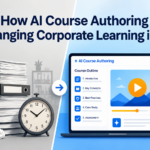
Talk to usBuilding a training course used to take months. Someone wrote a script, a subject expert reviewed it, a designer built slides, and everyone waited for the next round of edits. By the time the course launched, half the information was already outdated.
That timeline is shrinking. AI can now produce working drafts of scripts, quiz questions, and narration often turning a weeks-long build into a project measured in days.
In this post, we’ll look at what’s actually changed in corporate learning, where AI genuinely helps, and where a person still needs to step in.
What AI Course Authoring Actually Means
AI course authoring is the use of AI tools to generate the raw material a training course is built from.
Feed it a topic, some source material, or a rough outline, and it hands back a starting point not a finished course, but something a human can shape from there.
What’s automated now: Scripts, quizzes, storyboards, and narration can all be generated from a single prompt or a short outline. Each piece arrives ready for editing and review, not as content ready to publish as-is.
What still needs a human: None of this replaces judgment. Someone still has to check that the facts are right, that the tone fits the company, and that the course actually teaches what employees need. AI moves fast. It doesn’t always move accurately.
Why L&D Teams Are Adopting It Now
The biggest driver is time.
- Synthesia’s 2026 report on AI in learning and development found that 84% of L&D teams point to faster content production as the top benefit of AI, ahead of everything else on the list.
- The same report finds 87% of L&D teams are already using AI.
- 60% are using it for content and quiz drafting.
- 63% are using it for voice generation.
When a course build shrinks from weeks to days, a team can refresh corporate training as often as the business actually changes, instead of letting it sit stale between updates.
Four Ways AI Authoring Changes How Courses Get Built
1. Script and Storyboard Generation
Give the tool a topic or a rough outline, and it produces a script in minutes. Storyboards follow the same pattern a designer gets a rough version to edit and reshape instead of sketching every slide from a blank page. It’s a starting point, not a finished product, and one that once took days to reach.
2. Auto-Generated Quizzes and Assessments
The tool reads the course content and builds questions straight from it, so nobody has to sit down separately and write ten multiple-choice questions from scratch. A reviewer still checks each one for accuracy and relevance, but starting from a working version alone saves real time on most corporate training projects.
3. AI Voice and Avatar Narration
This is the part most people notice first. Platforms like netskill’s Genesis AI can turn a script into a narrated video with a realistic on-screen presenter, no camera or studio required. What once needed a hired voice actor and a recording session can now produce a usable narration in an afternoon, ready for a final review pass.
4. Fast Content Refresh
Policies change. Products change. Under the old process, a course sat outdated for months because rebuilding it felt like starting over. With AI authoring, updating a module often means editing the parts that changed and regenerating the rest in a matter of hours, not weeks.
This speed is becoming one of the main reasons corporate learning teams are rethinking how they build content.
If you’re weighing whether to build this in-house or bring in a platform that already does it, netskill’s AI-based training tools are built for exactly this kind of course authoring. Worth a look before you commit a team to building it from scratch.
Where It Works Best — and Where It Doesn’t
Strong Fit: Compliance, Onboarding, Product Updates
AI authoring shines where the content is high-volume and fact-based. Compliance refreshers, onboarding modules, and product knowledge updates follow a predictable structure and change on a schedule. That makes them easy for AI to draft and quick for a reviewer to check.
Weak Fit: Leadership Development, Sensitive Topics
Some things don’t work this way. Leadership development, conflict resolution, and harassment training need real practice, not a script someone reads or watches. An employee doesn’t learn how to handle a tense conversation by sitting through a narrated slide deck. They learn it by practicing the conversation itself.
This is where roleplay and simulation tools do what authored courses can’t. Instead of watching content, employees practice the actual skill of a difficult conversation, a sales pitch, a customer complaint and get feedback in real time.
We’ll cover how AI roleplay tools handle this in a separate post, but it’s worth knowing upfront: authoring and practice solve two different problems, and mixing them up is where a lot of corporate learning programs go wrong.
A Practical Rollout Plan
Don’t try to convert your whole course library at once.
- Pilot one course type. Onboarding is a good choice; it’s high-volume and low-risk if something needs a second pass.
- Review everything. Run that pilot with a human reviewer checking every single output before it reaches an employee, no exceptions, even once the tool starts looking reliable.
- Measure before scaling. Track two things: how much time you actually saved compared to building it the old way, and how many errors the reviewer caught that would’ve gone out otherwise.
- Expand or adjust. If the savings are real and the error rate is low, expand to a second course type. If the same mistakes keep showing up, that tells you where the tool fits in your workflow and where it doesn’t.
Treat the pilot as data, not a formality. Most teams that skip this step end up publishing something wrong and spend more time fixing it than they saved building it.
Risks Worth Taking Seriously
- Accuracy. AI-generated content can be wrong, and if nobody checks it before it goes live, employees end up learning the wrong thing with total confidence. This is the single biggest risk in AI course authoring, and it’s why a human review step isn’t optional.
- Data use. Some AI tools can use customer content to improve models, while others offer enterprise isolation. Before uploading internal material, confirm the vendor’s data-use policy and controls.
- Voice and brand. When every course sounds like it came out of the same tool, a company starts losing its own voice. Corporate learning should still sound like your company, not like generic AI output with your logo on it.
The Bottom Line
AI course authoring isn’t replacing the people who build corporate training. It’s replacing the slow parts, the blank page, the first draft, the hours spent formatting a quiz nobody enjoyed writing.
What’s left is the part that actually matters: deciding what employees need to learn and making sure the content is right before it reaches them. Teams that treat AI output as a starting point, not a finished product, are the ones getting real value out of it in 2026.
The technology moves quickly. The judgment behind it still has to come from a person.
Ready to see what AI-based course authoring could look like for your team? Talk to netskill and we’ll walk you through it.

NetSkill Enterprise Learning Ecosystem (LMS, LXP, Frontline Training, and Corporate Training) is the state-of-the-art talent upskilling & frontline training solution for SMEs to Fortune 500 companies.