NetSkill Wins Google For Startups Grant Of $350k!
Learn More >No. 1 Corporate Training & Upskilling Company in the World.
Talk to usMost articles about AI roleplay stay stuck in theory. They talk about personas, rubrics, and adaptive difficulty, but they rarely show what it feels like to actually sit through one. What does the AI say first? What happens if a trainee gives a weak answer? Does it feel like talking to a real person, or like filling out a form?
We wanted to answer that with something concrete instead of another overview. So we’re walking through an illustrative scenario from start to finish. What follows is representative rather than a transcript from any one tool, but it should give you a real feel for how a session plays out.
Before the session starts
A roleplay session doesn’t usually begin the moment a trainee opens the chat. Someone decides what the scenario should be, and how hard it should be, before that point.
Who sets up the scenario and persona
This job can fall to a few different people. An L&D admin might write the scenario by hand, picking the situation (an angry customer, a pricing objection, a compliance check) and deciding the person’s tone: rude, calm, confused, or in a hurry. A manager might request a scenario built around something that actually happened on the floor. Some tools can also generate scenarios from existing SOPs or scripts.
Whoever sets it up, the situation, the persona’s personality, and the difficulty level usually get defined before anyone practices.
What the trainee sees before starting
The trainee doesn’t walk in blind. Before the conversation starts, they get a short brief covering the context (who they’re about to talk to, and why) and the objective (what a good outcome looks like). Difficulty might be picked by the trainee, or the experience may adapt to the learner’s demonstrated level.
Once the brief is read, the trainee starts the session.
Minute by minute: an illustrative walkthrough
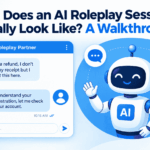
For this example, imagine a retail associate practicing a conversation with a customer who wants to return a blender with no receipt. This dialogue is written to illustrate how a session could unfold, not a transcript of an actual recorded session.
The opening
The AI doesn’t open with small talk. It steps into character right away:
“Hi, I bought this blender here two weeks ago and it stopped working. I want a refund.”
No narrator greeting, no “let’s begin the roleplay now.” The persona just becomes the customer, the way a real shopper might walk up already mid-thought.
The trainee replies the way they might on the floor: “I’m sorry to hear that. Do you have your receipt with you?”
The back-and-forth
This is the part where AI roleplay is meant to move past a fixed script. In a well-designed system, the AI responds to the trainee’s specific message rather than following only a set sequence.
“No, I don’t have it. I paid cash. But I bought it here, I’m sure of it.”
The trainee now has to decide: push for proof of purchase, offer store credit, or check a loyalty account for the sale. The AI’s next line should reflect whichever path the trainee takes, not a generic response to “objection handling” in the abstract.
A weak or off-script answer. Say the trainee gets flustered and says, “Sorry, there’s nothing I can do without a receipt.” The AI customer pushes back: “That’s ridiculous. I’m a regular here. Are you saying you don’t trust me?” A weak answer is meant to get noticed, not slide by quietly.
Handling it well. Now say the trainee tries again: “I get why that’s frustrating. Let me check if we can find your purchase under your phone number or loyalty account.” The AI customer softens: “Oh, okay. Yeah, I think I signed up for that. My number is [phone number].” The tone shift shows the AI responding to empathy plus a concrete next step.
How the AI adjusts based on performance
The AI keeps adjusting based on how the trainee performs rather than following one fixed script throughout. Stay calm and follow sound steps, and the persona calms down too. Skip empathy or lean too hard on policy language, and the persona gets more agitated, maybe asking for a manager. This kind of escalation and de-escalation is a core design goal for roleplay tools.
How the session ends
Eventually the conversation reaches a stopping point, either through a resolution or because the scenario hits a set limit. The trainee may receive feedback during or immediately after the session, depending on how the platform presents its results.
What happens after the conversation ends
The conversation ending isn’t the end of the session’s value. What happens next is where a lot of the actual training payoff shows up.
How scoring and feedback work
Some platforms evaluate a session against a rubric set up in advance, often by whoever wrote the scenario. For our blender return example, that rubric might check whether the trainee acknowledged the customer’s frustration, followed the return policy correctly, or offered an alternative instead of a flat no.
A well-designed rubric makes evaluation more structured and comparable than an unaided human judgment call, though AI-generated scores still benefit from occasional human review rather than being treated as fully self-validating. The specific format varies by platform: some show a single score out of 10 or a label like “Needs Improvement,” others pair that with detailed notes such as “You acknowledged the customer’s frustration here” or “Consider offering the loyalty lookup earlier next time.” Where that level of detail is available, it tends to help the trainee more than a single number on its own.
We’re building this kind of practice into Genesis AI, alongside course generation and other training tools, so the details of how content and roleplay connect will be confirmed closer to launch. If you want to see how it works for your team, book a demo.
What managers may see
Some platforms also give managers progress reports and team-level trends, such as who has practiced recently or which rubric items come up as missed most often. Features like branch-level filtering or full transcript access exist on some platforms but aren’t universal, so it’s worth checking what a specific tool actually offers before you commit to it.
Chat vs. voice
The walkthrough above is written as a chat exchange. Where voice roleplay is available, the experience also brings in tone, pace, pauses, and delivery, things a text transcript can’t capture. That matters most for roles where the real conversation happens on a call or face to face. Chat suits written support or policy-heavy scenarios well; voice adds a layer relevant to jobs where how something is said matters as much as what is said.
What makes a session feel real
A well-built session holds onto context from earlier in the conversation, so it doesn’t ask the trainee to repeat information already given. It also responds with something specific to what the trainee just said, rather than a generic acknowledgment. A weaker implementation shows its limits fast: repeating itself, losing track of earlier exchanges, or defaulting to the same soft response no matter what’s said. Once a trainee notices that, the exercise starts to feel less like practice and more like filling out a form.
Where this fits, and what to look for
A single session is unlikely to build a skill on its own. The value comes from repetition: running the same scenario more than once, then a harder version, then a different objection entirely, paired with feedback each time.
If you’re evaluating any platform, it’s worth going beyond a scripted demo. Try pushing back mid-conversation or giving a deliberately vague answer, and see how the system actually responds. Try it yourself and judge it on a scenario relevant to your team.



NetSkill Enterprise Learning Ecosystem (LMS, LXP, Frontline Training, and Corporate Training) is the state-of-the-art talent upskilling & frontline training solution for SMEs to Fortune 500 companies.