NetSkill Wins Google For Startups Grant Of $350k!
Learn More >No. 1 Corporate Training & Upskilling Company in the World.
Talk to usA mobile LMS for frontline employee training is a learning platform built for employees who do not work at desks. It helps organizations deliver training through mobile devices, short modules, assessments, videos, checklists, notifications, and performance tracking.
For HR and L&D leaders, the value is simple: frontline teams need learning that fits into work, not training that pulls them away from it. Retail staff, field teams, factory workers, service technicians, warehouse employees, healthcare support teams, and sales promoters often cannot sit through long desktop-based courses. They need mobile-first, role-based, and easy-to-complete learning. A mobile LMS solves this by putting training directly into the hands of workers. The best frontline training programs use microlearning, multilingual content, offline access, reminders, quizzes, manager dashboards, and skill tracking to improve completion and job readiness.
Explore NetSkill Frontline Training
Why do traditional frontline training programs fail?
Traditional frontline training programs fail because they are often too long, too generic, and too disconnected from daily work. Frontline employees need practical learning that helps them perform tasks better, faster, and more safely.
Most classroom-heavy or desktop-based training models were designed for office employees. Frontline teams work across shifts, locations, languages, and operational pressure. If training requires a laptop, fixed schedule, or long session, participation drops. The result is low completion, inconsistent knowledge, compliance gaps, and managers repeating the same instructions on the floor. A mobile LMS improves this by delivering learning in short, focused modules that employees can access during breaks, before shifts, or at the point of need. For HR and L&D teams, this creates a scalable way to standardize workforce training solutions across distributed locations without slowing operations.
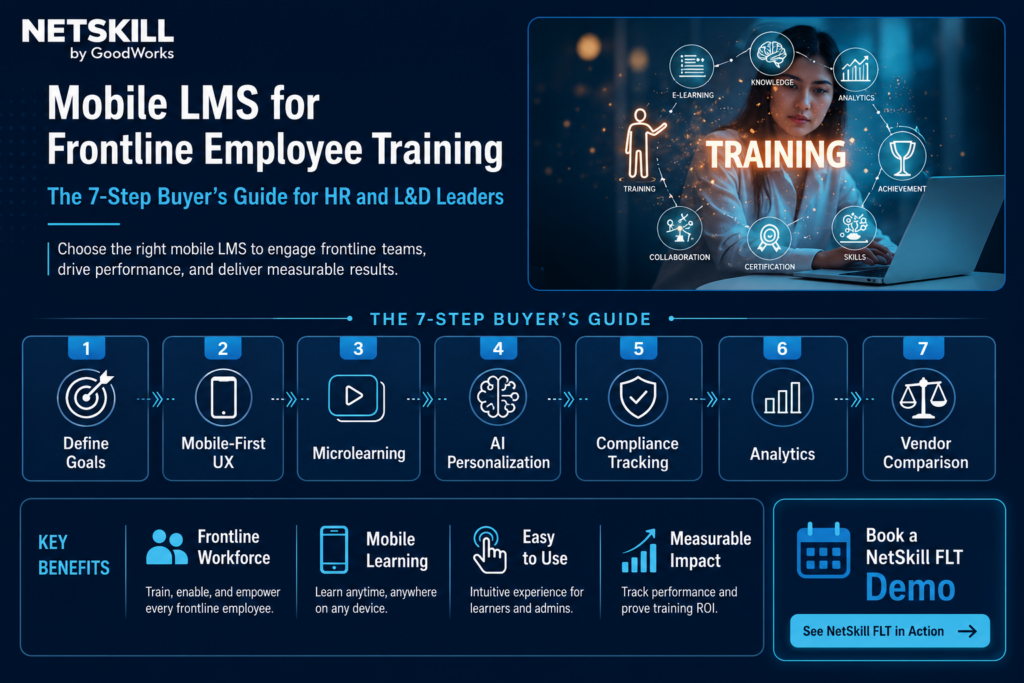
Step 1: How should you define frontline employee training goals?
You should define frontline employee training goals by connecting learning outcomes to business outcomes. Start with the operational problems you want training to solve, such as faster onboarding, fewer errors, better compliance, improved customer service, or higher productivity.
Before evaluating any mobile LMS, list your frontline roles and the skills each role needs. A retail associate may need product knowledge, POS training, customer handling, and store SOPs. A factory worker may need safety training, equipment handling, quality checks, and compliance certification. A logistics employee may need route protocols, scanning processes, packaging rules, and escalation steps. The goal is not to upload random courses. The goal is to build frontline training programs that support real work. Strong workforce training solutions allow HR teams to map content by role, region, department, skill level, and manager priority.
Step 2: What mobile-first features should HR and L&D leaders check?
HR and L&D leaders should check whether the LMS works smoothly on mobile devices, supports quick learning, and makes training easy for employees with limited time. Mobile-first design is not optional for frontline employee training; it is the foundation.
Look for responsive design, mobile app access, low-bandwidth performance, offline learning, push notifications, QR-based access, simple navigation, and short modules. The platform should support videos, audio, PDFs, quizzes, flashcards, checklists, surveys, and interactive content. It should also work across Android and iOS because frontline teams often use mixed devices. A good mobile LMS should feel simple enough for employees who are not frequent technology users. If learners need repeated support just to access training, the platform will fail. NetSkill’s frontline training approach fits this need by focusing on mobile-friendly, on-the-go learning for distributed teams.
Step 3: How important is microlearning for frontline training programs?
Microlearning is highly important because frontline employees usually learn better in short, focused bursts than in long training sessions. It helps workers complete training without leaving their work environment for extended periods.
The strongest frontline training programs break content into modules that can be completed in three to seven minutes. One module may cover a safety step, one customer objection, one product feature, or one compliance rule. This makes learning easier to consume, remember, and apply. Microlearning also helps managers reinforce training over time instead of overwhelming employees in one session. For example, a new warehouse employee can receive one lesson on scanning, one on packing, one on escalation, and one on safety. This approach is more practical than forcing a full-day course before the employee has context. For workforce training solutions, microlearning improves consistency and repeatability.
Step 4: What role should AI play in workforce training solutions?
AI should help personalize learning, recommend content, identify skill gaps, and reduce manual work for HR and L&D teams. It should not replace good training design; it should make frontline employee training more relevant and scalable.
AI-powered workforce training solutions can recommend modules based on role, performance, assessment scores, language, and learning history. For example, if an employee fails a safety quiz, the LMS can suggest a refresher module. If a sales promoter struggles with product knowledge, the system can recommend targeted learning before the next shift. AI can also help L&D teams create quizzes, summarize content, generate learning paths, and analyze training gaps. The real value is personalization at scale. Instead of giving every frontline employee the same course, AI helps deliver the right training to the right person at the right time.
Step 5: How should you evaluate compliance and certification tracking?
You should evaluate compliance tracking by checking whether the LMS can assign, monitor, remind, and report mandatory training across roles and locations. For frontline industries, compliance is not just an L&D metric; it is an operational risk.
Retail, manufacturing, logistics, healthcare, BFSI, and field service teams often need recurring compliance training. This may include workplace safety, data privacy, product handling, hygiene protocols, equipment usage, emergency response, POS rules, or regulatory certifications. A strong mobile LMS should show who has completed training, who is overdue, who failed assessments, and which certifications are expiring. It should also support automated reminders, manager alerts, downloadable reports, and audit-ready records. When compliance tracking is manual, gaps are easy to miss. When it is built into frontline training programs, HR teams can improve accountability without chasing every location manually.
Step 6: What analytics should a mobile LMS provide?
A mobile LMS should provide analytics on completion, engagement, assessment performance, skill gaps, overdue training, manager-level progress, and location-wise adoption. Without analytics, frontline employee training becomes activity tracking instead of performance improvement.
HR and L&D leaders should look beyond login reports. Useful analytics should answer practical questions. Which locations are falling behind? Which roles are failing assessments? Which modules are being skipped? Which managers need support? Which skills are improving? Which training content is not working? The best workforce training solutions help leaders connect learning data to business outcomes. For example, if customer complaints reduce after service training, or safety incidents drop after refresher modules, L&D can show impact. Analytics also helps improve content. If many employees fail the same quiz question, the issue may be unclear training, not poor learner effort.
Step 7: How should you compare mobile LMS vendors?
You should compare mobile LMS vendors on usability, mobile performance, role-based learning, microlearning support, analytics, compliance tracking, integrations, AI capability, and implementation support. The right vendor should understand frontline realities, not just LMS features.
Ask each vendor to demonstrate a real frontline use case. How does a new employee receive onboarding? How does a manager track completion? How does the system work on low bandwidth? Can content be assigned by role and location? Does it support multilingual learning? Can HR export compliance reports? Does it integrate with HRMS, payroll, attendance, or identity systems? Also evaluate customer support, implementation timeline, content migration, admin training, and scalability. A good vendor will help you design a rollout plan. A weak vendor will only show dashboards. NetSkill FLT should be positioned as a practical option for enterprises that need mobile-first frontline training at scale.
What mistakes should buyers avoid when selecting a mobile LMS?
Buyers should avoid choosing a mobile LMS only because it has many features. The better decision is to choose a platform that frontline employees will actually use and managers can actually track.
Common mistakes include ignoring low-bandwidth access, skipping multilingual needs, choosing long-course formats, underestimating manager dashboards, and failing to define success metrics before rollout. Another mistake is buying a general LMS and expecting it to work for deskless teams without customization. Frontline employee training needs a different learning rhythm. Content must be short, clear, searchable, role-based, and easy to access. HR teams should also avoid launching too many modules at once. A phased rollout works better: onboarding first, compliance next, role-based skills after that, and performance-linked learning once adoption improves.
How can NetSkill support frontline employee training at scale?
NetSkill can support frontline employee training by helping enterprises deliver mobile-friendly, AI-powered, role-based learning for distributed workforces. It is built for teams that need scalable frontline training programs across locations, roles, and operational environments.
NetSkill FLT focuses on practical learning delivery for frontline teams. HR and L&D leaders can use it to support onboarding, compliance, skill development, assessments, manager visibility, and continuous learning. Its mobile-first approach helps employees learn without depending on classroom sessions or desktop access. For enterprises, the bigger benefit is standardization. Every location can receive consistent training while managers still get visibility into local progress. This makes NetSkill relevant for retail, manufacturing, logistics, healthcare, BFSI, field sales, and service teams. For organizations looking for workforce training solutions that match frontline realities, NetSkill FLT offers a focused path.
Conclusion: What is the best way to choose a mobile LMS for frontline teams?
The best way to choose a mobile LMS is to start with frontline work realities and then evaluate the platform against those needs. A good system should make training easier for employees, simpler for managers, and more measurable for HR and L&D leaders.
The strongest frontline training programs are mobile-first, short, role-based, multilingual, measurable, and connected to business outcomes. They help employees learn faster without disrupting daily operations. They also give leaders the visibility needed to improve compliance, productivity, onboarding, and skill development. In 2026, workforce training solutions should not be built only for office employees. They must work for the people who run stores, factories, warehouses, branches, field operations, and customer-facing teams every day.
If your organization wants to modernize frontline employee training, start by reviewing your current training gaps and mapping them to a mobile-first LMS strategy.
Recent Post



NetSkill Enterprise Learning Ecosystem (LMS, LXP, Frontline Training, and Corporate Training) is the state-of-the-art talent upskilling & frontline training solution for SMEs to Fortune 500 companies.