NetSkill Wins Google For Startups Grant Of $350k!
Learn More >A practical, step-by-step guide for B2B leaders, HR heads, and procurement teams who need to justify workforce training investments and get approval from the C-suite.
You know your workforce needs better training. Your managers are stretched thin. Your onboarding takes too long. Your compliance deadlines are a recurring headache. The solution seems obvious bring in a professional corporate training company.
But then comes the harder question: How do you convince the boardroom?
Getting budget approval for outsourced employee training is one of the most common challenges for HR leaders, L&D managers, and B2B business owners. Without a structured business case, even the most genuine training need can get dismissed as a “nice to have.” This guide walks you through exactly how to build a persuasive, data-backed case that earns sign-off and shows how a platform like Netskill turns that approval into measurable results.
Why this matters in 2026: Skills are becoming obsolete every 18–24 months. Companies that fail to invest in structured workforce upskilling today are building a talent crisis for tomorrow. A well-built business case is the first step toward making training a strategic priority not an afterthought.
Why Companies Struggle to Justify Corporate Training Budgets
The biggest barrier to outsourcing corporate training isn’t budget it’s the inability to quantify value. Finance teams and CEOs think in outcomes, numbers, and risk. Most training proposals speak in activities: “We’ll run 12 workshops.” “We’ll cover leadership development.” That framing loses before the meeting begins.
Here’s what typically goes wrong:
- Training ROI isn’t tied to any specific business metric (revenue, retention, productivity)
- The cost of not training is never calculated only the cost of training is presented
- The proposal doesn’t address the make-or-buy question clearly
- No baseline data exists to compare results against after training
- The right stakeholders (CFO, COO, department heads) aren’t included early enough
When you avoid these pitfalls and structure your proposal the right way, the conversation shifts from “Can we afford this?” to “Can we afford not to?” That’s the goal of a strong business case.
Not sure where to start?
Talk to a Netskill L&D expert we’ll help you map your skill gaps before you write a single slide.
Step 1 — Define the Business Problem, Not the Training Solution
The first rule of a winning business case: lead with the problem, not the solution. Your executive team doesn’t care about learning management systems or blended learning methodologies at least not yet. They care about the business problem those tools solve.
Start by identifying the specific, measurable pain points your business is facing. This is where your business case gains its credibility.
Questions to anchor your problem statement
1. What is this skill gap costing us right now?
Quantify the impact. If your sales team closes 20% fewer deals than industry benchmarks because of weak negotiation skills, calculate that gap in revenue terms. If onboarding takes 90 days instead of 45, calculate the lost productivity cost per new hire.
2. What compliance or regulatory risk do we carry?
For industries like BFSI, pharma, or manufacturing, unmet compliance training creates legal exposure. Put a number on the potential fine or audit cost it immediately reframes training as risk mitigation, not expenditure.
3. What is our current employee attrition costing us?
Studies consistently show that employees who don’t receive structured development leave faster. If you’re losing 15–20% of your workforce annually, replacing each employee costs 50–200% of their annual salary. That’s a powerful number to put in front of a CFO.
4. How fast is our industry changing?
With AI reshaping job roles and the average skill half-life shrinking to under two years, workforce development is no longer optional. Build this urgency into your problem statement with industry data your leadership team recognises.
Pro tip: Frame the problem as a business risk, not an HR concern. “Our workforce is not equipped to operate our new ERP system” lands better than “employees need more training.” One belongs in a risk register; the other belongs in a wish list.
Step 2 — Conduct a Skills Gap Analysis Before You Write the Proposal
A business case without diagnostic data is just an opinion. Before you propose any outsourced training solution, conduct a structured skills gap analysis across your target workforce. This gives your proposal an evidence base that’s hard to argue with.
A skills gap analysis maps current employee competencies against what the role and the business actually requires. The gap between those two points is where your training investment is directed. Without it, you’re guessing.
Key dimensions to assess in your skills gap analysis:
- Technical skills specific to each role or department
- Leadership and management capabilities at mid and senior levels
- Digital literacy and adoption of internal tools and platforms
- Compliance knowledge relevant to your industry
- Soft skills communication, collaboration, problem-solving
The output of this analysis gives you two things that your business case desperately needs: a clear scope for the training programme and a baseline measurement to demonstrate ROI after delivery.
Struggling to identify skill gaps across your teams?
Netskill’s AI-powered skills intelligence engine conducts 360° assessments across your workforce identifying gaps, recommending learning paths, and generating audit-ready reports in days, not weeks.
Start Your Skills Assessment | See How It Works
Step 3 — Build the ROI Framework That Wins Boardroom Approval
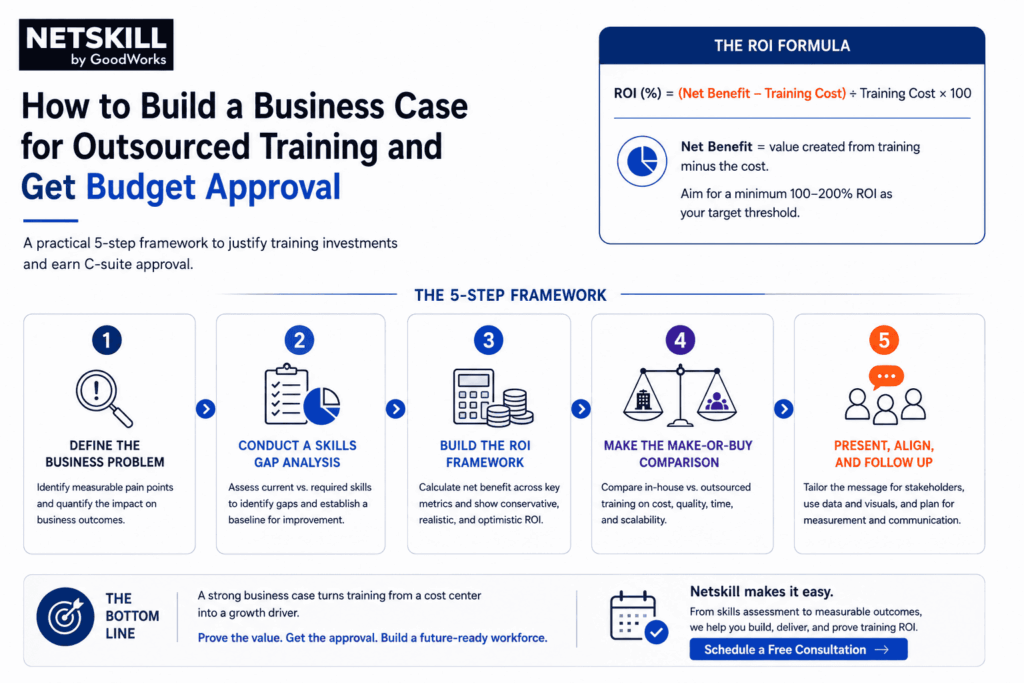
This is where most training proposals fall flat and where yours needs to stand out. Your CFO needs to see a credible return on investment calculation, not a promise. Here’s the framework to use.
TRAINING ROI FORMULA
ROI (%) =
(Net Benefit − Training Cost)
÷ Training Cost ×
100
(Net Benefit − Training Cost)
÷ Training Cost ×
100
Net Benefit = value created from training minus the cost. Aim for a minimum 100–200% ROI as your target threshold.
How to calculate “Net Benefit” in real terms
Quantifying training benefits is the hardest part but it’s also the most persuasive. Here are the four benefit categories to build into your calculation:
| Benefit Category | Example Metric | How to Quantify |
|---|---|---|
| Productivity gain | Faster onboarding time | Days saved × employee daily cost |
| Retention improvement | Reduced attrition rate | Employees retained × replacement cost |
| Revenue impact | Improved sales close rates | Incremental deals × average deal value |
| Risk reduction | Compliance training completion | Potential fine avoided × probability |
A real-world example: if outsourced employee training programmes reduce your average onboarding time from 90 days to 50 days for 40 new hires annually, and each employee costs ₹800 per productive day, that’s a productivity gain of ₹12.8 lakh per year before you even count retention savings or revenue impact.
Important: Always include the cost of not training in your proposal. If the status quo costs more than the training investment through attrition, errors, lost deals, or compliance penalties that’s often the most persuasive number in the entire document.
Step 4 — Make the In-House vs. Outsourced Training Comparison
Your executive team will almost certainly ask: “Why can’t we just do this internally?” That’s a fair question, and you need a direct, well-reasoned answer. The in-house vs. outsourced training question is one of the most important workforce development decisions a business makes and the answer depends on a few key factors.
| Factor | In-House Training | Outsourced Corporate Training |
|---|---|---|
| Speed to deploy | Slow — needs content creation, trainer hiring | Fast — expert content and delivery ready to go |
| Content depth | Limited by internal expertise | Industry specialists with up-to-date curricula |
| Scalability | Constrained by headcount and time | Scales across teams, locations, and time zones |
| Technology | Requires separate LMS investment | Included in platform (LMS + LXP + analytics) |
| Measurability | Hard to track without dedicated tools | Real-time dashboards, completion tracking, ROI reports |
| Cost structure | High fixed costs (salaries, tech, content) | Variable, predictable per-learner pricing |
For most growing businesses and enterprises, outsourcing to a specialist corporate training company delivers faster time-to-value, deeper expertise, and better measurement at a total cost that frequently undercuts building the capability in-house.
Step 5 — Select the Right Corporate Training Partner (And What to Look For)
Your business case isn’t just an argument for training it’s an argument for a specific partner. The vendor you choose determines whether your investment delivers or disappoints. Here are the six criteria every B2B buyer should evaluate when shortlisting a corporate training provider:
- AI-powered personalisation: Does the platform adapt learning paths to individual roles, performance levels, and career goals — or does everyone get the same content?
- Blended learning capability: Can it support instructor-led sessions, self-paced online modules, and on-the-job learning in one ecosystem?
- Measurable analytics: Will you get data on completion rates, skill growth, and business impact or just attendance logs?
- Scalability: Can the platform handle your current headcount and your growth projections two years from now?
- Industry-specific content: Does the provider have domain expertise in your vertical, or is the content generic?
- Integration capability: Will it connect with your existing HRMS, CRM, or productivity tools without a major implementation project?
Why Netskill Is Built for This Business Case
If you’re building a business case for outsourced corporate training, the platform you choose to anchor it with matters enormously. Netskill is India’s leading AI-powered corporate training and upskilling platform trusted by enterprises from SMEs to Fortune 500 companies and it’s designed to make every element of your business case defensible.
Here’s what sets Netskill apart as a corporate training company built for measurable outcomes:
- AI-Powered Learning Paths : Netskill’s skills intelligence engine automatically builds personalised learning journeys based on each employee’s role, current competencies, and career goals no manual curation required.
- LMS + LXP in One Ecosystem : Combines structured compliance-ready LMS delivery with a flexible, learner-centric LXP covering everything from onboarding and compliance to leadership development and technical upskilling.
- Mobile-First, Offline Access : Multi-language support and offline capability make Netskill ideal for distributed teams, frontline workers, and organisations with employees across multiple geographies.
- ROI-Ready Analytics : Real-time dashboards track engagement, skill growth, completion, and business impact giving you the data you need to report training ROI to the C-suite with confidence.
With a library of over 5,000 courses and a user base exceeding 150,000 learners across industries, Netskill brings both depth of content and proof of scale to your business case. Whether you’re training 50 employees or 5,000, the platform grows with you.
What makes Netskill different from a traditional corporate training company: Most providers offer content. Netskill offers a complete learning intelligence ecosystem combining AI-driven content delivery, skills tracking, blended learning, social learning, frontline training, and advanced analytics in a single, integrated platform. It doesn’t just train your workforce. It transforms how your organisation builds capability.
Ready to Build Your Business Case with Real Data?
Our L&D consultants will walk you through a skills gap assessment, help you model your training ROI, and show you exactly how Netskill fits into your workforce development strategy no commitment required.
Step 6 — Structure Your Business Case Document for Maximum Impact
Once you have your data, your ROI model, and your vendor selection, it’s time to put it all on paper. A business case for outsourced corporate training should follow a clear, executive-friendly structure. Here’s the recommended format:
1. Executive Summary (1 page)
State the business problem, the proposed solution, the expected ROI, and the recommended timeline. This is what your CEO reads. Make it count.
2. Problem Statement with Evidence
Present the skills gap data, attrition figures, productivity losses, and compliance risks. Use your baseline data from the skills gap analysis here.
3. Options Considered (with Make/Buy Analysis)
Show that you evaluated in-house training as an option and explain with data why outsourcing delivers superior value. This demonstrates rigour.
4. Recommended Solution and Vendor
Present your chosen workforce training partner, the programme scope, the delivery model, and the cost structure. Include Netskill’s platform features and relevant case studies or client references.
5. ROI Projection and KPIs
Present your ROI calculation with conservative, base, and optimistic scenarios. Define the KPIs you will track: onboarding time, attrition rate, skill assessment scores, compliance completion, productivity benchmarks.
6. Implementation Timeline and Risk Mitigation
Outline the rollout plan, identify potential risks, and show how they’ll be managed. Demonstrating risk awareness builds credibility with risk-averse stakeholders.
Conclusion: Training Is an Investment, Not a Cost
The organisations winning in 2026 aren’t the ones with the biggest training budgets they’re the ones that treat employee development as a measurable business function with clear inputs, clear outputs, and accountability at every stage.
Building a business case for outsourced corporate training is not about convincing sceptics that training is good. It’s about translating a genuine business need into the language your decision-makers use every day: risk, return, scale, and competitive advantage.
Start with the problem. Back it with data. Model the return. Choose a partner like Netskill that gives you the platform, the content, and the analytics to prove the investment was worth it. Then build on those results quarter by quarter.
The business case doesn’t end at approval. It continues every time a Netskill dashboard shows your leadership team exactly how much further your workforce has come and how far it still has to go.
Turn Your Training Vision into a Board-Approved Strategy
Join 150,000+ learners across enterprises and fast-scaling companies who’ve transformed their workforce with Netskill’s AI-powered corporate training platform.


NetSkill Enterprise Learning Ecosystem (LMS, LXP, Frontline Training, and Corporate Training) is the state-of-the-art talent upskilling & frontline training solution for SMEs to Fortune 500 companies.