AI has entered corporate learning faster than most L&D teams expected. In 2026, the question is no longer whether companies should use AI in learning. The real question is sharper: which parts of AI actually improve employee capability, and which parts are just shiny noise?
That distinction matters because corporate learning budgets are under pressure. Business leaders want proof. HR and L&D teams want engagement. Employees want training that feels relevant to their work, not another generic module they are forced to complete.
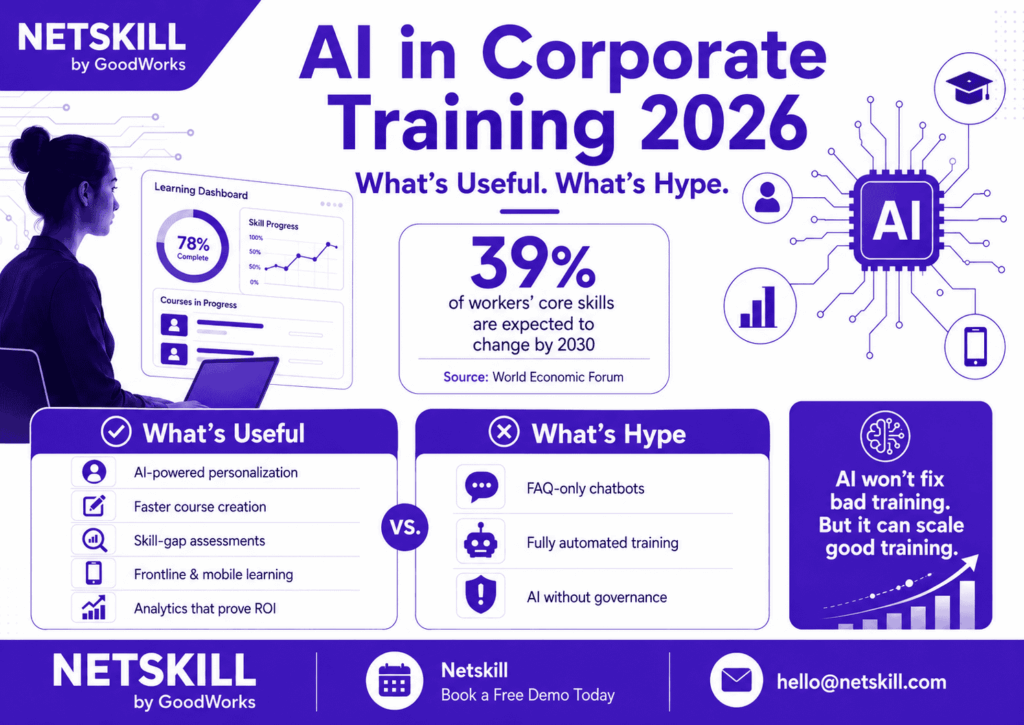
The pressure is real. The World Economic Forum’s Future of Jobs Report 2025 found that employers expect 39% of workers’ core skills to change by 2030, which means companies cannot rely on outdated annual training calendars anymore. Skills are moving too fast. Learning has to become continuous, personalized, measurable, and business-linked.
This is exactly where AI can help. But AI is not useful just because it is AI. It becomes useful only when it solves practical problems in corporate training solutions such as content creation speed, learning personalization, skills tracking, assessment quality, frontline access, and training ROI.
Let’s break down what is genuinely useful in AI corporate training in 2026, what is hype, and how enterprises can make smarter decisions.
Why AI Matters in Corporate Training Solutions in 2026
Corporate training has traditionally faced three major problems.
First, training content takes too long to create. By the time a course is designed, reviewed, approved, and delivered, the business requirement may already have changed.
Second, most learning paths are too generic. Employees in different roles, regions, departments, and experience levels are often given the same content, even when their actual skill gaps are different.
Third, L&D teams struggle to prove business impact. Completion rates and attendance numbers are not enough. Leadership wants to know whether training improved productivity, compliance, retention, role readiness, or performance.
AI helps when it connects learning with business outcomes. According to LinkedIn’s Workplace Learning Report 2025, many career development-focused organizations see generative AI as a competitive advantage that can be scaled across roles and proficiency levels, from basic AI fluency for administrative roles to advanced AI capabilities for technical teams.
In other words, AI is not just changing how employees learn. It is changing what employees need to learn.
That is why modern corporate training solutions need more than a content library. They need AI-powered learning paths, skill intelligence, automated recommendations, analytics, assessments, and role-based training experiences.
What’s Useful: AI-Powered Personalization
The most practical use of AI in corporate training is personalization.
In older LMS systems, learning was usually assigned based on department or designation. A sales executive, team lead, or support engineer would be pushed into a fixed course path. But real learning needs are more nuanced.
AI can analyze learner performance, quiz results, completed courses, career goals, role expectations, and skill gaps to recommend the next best learning action. That makes learning journeys far more relevant and efficient.
This is useful because employees do not waste time on what they already know. New joiners can get foundational content. High performers can move faster into advanced topics. Struggling learners can receive supplementary resources, practice quizzes, or alternative learning material.
For L&D teams, this improves relevance. For employees, it improves motivation. For business leaders, it improves training efficiency.
What’s Useful: Faster Course Creation with AI
One of the biggest bottlenecks in enterprise learning is content creation. Every L&D team knows the pain: subject matter experts are busy, course designers need inputs, compliance teams want accuracy, and business teams want everything yesterday.
AI can reduce this burden by helping convert documents, policies, PDFs, PPTs, SOPs, and training material into structured learning content. It can assist with learning objectives, module outlines, assessments, summaries, scenarios, and knowledge checks.
This does not mean AI should replace instructional design. That is hype. What AI can do well is speed up the first draft, organize raw information, create learning variations, and help L&D teams scale content faster.
For companies running large onboarding, compliance, product training, sales enablement, and frontline training programs, this becomes a serious advantage.
This is where AI becomes valuable: not as a magic writer, but as a productivity layer for corporate training solutions.
What’s Useful: AI Assessments and Skill Gap Visibility
Training without assessment is guesswork.
In 2026, companies need to know who is ready, who needs support, and where the organization is exposed. This is especially important for industries like BFSI, healthcare, IT services, manufacturing, retail, logistics, and GCCs, where skills gaps directly affect delivery quality, compliance, customer experience, and productivity.
AI-powered assessments can help evaluate learning retention, recommend remediation, and identify patterns across teams. They also help L&D teams move beyond basic completion dashboards and into more meaningful skill visibility.
That means leaders can answer better questions:
-
Which teams are ready for a new process rollout?
-
Which employees need additional coaching?
-
Which skills are weak across a department?
-
Which training programs are actually improving performance?
That is the shift from training administration to workforce intelligence.
What’s Useful: AI for Frontline and Mobile Learning
AI in corporate training is often discussed from a white-collar, office-worker perspective. But a major opportunity sits with frontline teams.
Frontline employees often face different learning barriers: limited desktop access, language diversity, shift schedules, low time availability, distributed locations, and immediate task pressure. Traditional training programs often fail here because they are too long, too English-heavy, too classroom-dependent, or too disconnected from field realities.
Modern corporate training solutions must support mobile learning, multilingual access, bite-sized content, reminders, assessments, and performance nudges.
This makes AI useful when it adapts learning to the worker’s environment instead of forcing every learner into the same desktop LMS experience.
What’s Useful: Learning Analytics That Speak Business Language
The best AI use case in training may not be content or chatbots. It may be analytics.
Most L&D teams still report basic metrics: attendance, course completion, quiz scores, and feedback forms. These are helpful, but they do not tell the full story.
Business leaders want sharper answers:
-
Did onboarding time reduce?
-
Did sales productivity improve?
-
Did compliance risk reduce?
-
Did support quality improve?
-
Did employees become project-ready faster?
-
Did training help retention?
The TalentLMS 2026 Annual L&D Benchmark Report notes that training and skill development are strongly linked to retention, with 95% of HR managers agreeing that better training improves employee retention and 73% of employees saying stronger L&D opportunities would make them stay longer.
That is why AI-powered dashboards matter. Useful AI does not just make learning look modern. It helps L&D prove value.
What’s Hype: AI Chatbots That Only Answer FAQs
AI chatbots are useful when they provide contextual learning support, explain concepts, remind learners, help navigate courses, and guide employees through role-specific learning journeys.
But many AI chatbots in training platforms are still glorified FAQ bots. They answer basic platform questions but do not deeply understand skill gaps, business roles, training outcomes, or performance context.
That is hype.
A chatbot should not be considered a major AI training innovation unless it improves learning completion, learner confidence, assessment performance, or support efficiency.
The key is integration. A chatbot sitting outside the learning journey is a feature. A chatbot embedded into the learning journey can become a coach.
What’s Hype: Fully Automated Training Without Human Experts
There is a dangerous assumption in the market that AI can fully automate corporate learning.
It cannot.
AI can generate content. It can recommend learning paths. It can analyze performance. It can support assessments. But human expertise is still essential for instructional quality, business context, compliance accuracy, cultural relevance, coaching, facilitation, and leadership development.
This is especially true for soft skills, communication, leadership, sales, negotiation, cybersecurity awareness, AI ethics, and role-based functional training.
The future is not AI replacing trainers. The future is AI helping trainers, SMEs, and L&D teams deliver better programs faster.
That blend matters because corporate training solutions need both intelligence and human judgment.
What’s Hype: AI Without Governance
AI adoption in the workplace is accelerating, but many employees are still left to figure out tools on their own. A recent Nexthink study reported that while 28% of workers use AI tools several times a week, only 16% had received formal AI training from their employers.
That gap creates risk. Employees may use unofficial tools, upload sensitive data, misunderstand AI outputs, or rely on inaccurate responses.
In corporate training, AI without governance can create problems such as biased recommendations, poor-quality generated content, privacy concerns, hallucinated answers, and unreliable assessments.
So the useful question is not: “Does your LMS have AI?”
The better question is: “Does your AI-powered learning platform support secure, measurable, role-based, and compliant training?”
That is why AI training should include clear policies, responsible AI usage, data privacy standards, learner controls, and admin oversight.
How Netskill Helps Enterprises Use AI Where It Actually Matters
Netskill is built for organizations that want AI to improve workforce capability, not just decorate their LMS with modern features.
Its enterprise learning ecosystem includes:
-
AI-powered LMS for onboarding, compliance, structured learning, progress tracking, and automated workflows.
-
LXP capabilities for personalized learning, social learning, collaborative growth, modern content formats, and engagement.
-
Frontline training for distributed teams that need mobile-first, accessible learning.
-
AI assessments and analytics to measure learner progress, identify gaps, and improve training decisions.
-
Corporate training services with 5000+ courses and 5000+ certified trainers across technology, business, creative, and professional skills.
-
Gamification and mobile access to improve completion and learner motivation.
What this really means is that Netskill helps companies move from scattered training activities to a connected learning ecosystem.
For HR leaders, this means better employee development.
For L&D teams, it means faster execution and better tracking.
For business leaders, it means training that can be linked to productivity, readiness, retention, and performance.
The 2026 Checklist: How to Separate Useful AI from Hype
Before investing in any AI-powered corporate training platform, ask these questions:
-
Does it personalize learning by role, skill, and performance?
-
Can it reduce course creation time without compromising quality?
-
Does it support assessments and skill-gap tracking?
-
Can it serve frontline, remote, and mobile-first employees?
-
Does it provide analytics beyond completion rates?
-
Can it integrate with HR systems and business workflows?
-
Does it include human-led training support when needed?
-
Does it follow data privacy and compliance best practices?
-
Can it prove training impact to leadership?
If the answer is mostly no, the AI may be more hype than value.
If the answer is yes, then AI becomes a serious driver of workforce transformation.
Conclusion: AI Will Not Fix Bad Training. But It Can Scale Good Training.
AI is not a shortcut for poor training strategy. It will not automatically make employees more skilled, engaged, or productive.
But when used correctly, AI can make corporate training solutions faster, smarter, more personalized, and more measurable.
In 2026, the companies that win will not be the ones buying the flashiest AI tools. They will be the ones using AI to solve real learning problems: skill gaps, onboarding delays, compliance risk, low engagement, inconsistent frontline training, and weak training ROI.
That is the role Netskill is built to play. With its AI-powered LMS, LXP, frontline training, assessments, analytics, trainer network, and end-to-end corporate training solutions, it helps enterprises turn learning into a measurable business advantage.