A decade ago, digital literacy meant knowing how to navigate spreadsheets, email, and cloud tools. In 2026, that bar has moved. Employees are now expected to prompt, evaluate, and collaborate with AI systems as a routine part of their jobs not as a specialized skill reserved for data teams. Organizations that treat AI fluency as optional are already falling behind those that have embedded it into everyday work. This shift is exactly why more L&D leaders are turning to an AI-powered LMS for corporate training: a platform built to teach AI skills at scale while also using AI to personalize how that teaching happens. This blog breaks down what AI fluency actually means, why it matters now, and how the right learning technology can close the gap before it becomes a competitive liability.
What Is AI Fluency, and Why Does It Matter for Corporate Training in 2026?
AI fluency is the ability to use, question, and responsibly apply AI tools within day-to-day work not just technical knowledge of how models function. It matters in 2026 because AI has moved from a specialist function into nearly every role, from finance to customer support to product design. Employees who can’t work alongside AI tools are becoming as limited as those who once couldn’t use a computer.
Unlike digital literacy, which focused on operating software, AI fluency requires judgment: knowing when an AI output is reliable, when it needs human review, and how to phrase requests that produce useful results. This is a skill gap most companies haven’t formally addressed. Corporate training solutions built around structured, role-specific AI curricula are becoming the standard response, because ad hoc exposure to AI tools rarely produces consistent, safe, or productive usage across a workforce.
Why Is an AI-Powered LMS for Corporate Training Essential for Building Workforce AI Fluency?
An AI-powered LMS for corporate training is essential because it can teach AI skills using the same intelligent personalization it applies to any other subject adapting pace, content, and assessments to each learner’s role and current skill level. Generic, one-size-fits-all training modules struggle to address the wide range of AI maturity that exists across a typical organization, from complete beginners to employees already experimenting informally with tools like chatbots or copilots.
A modern AI-powered learning management system solves this by using learner data to recommend the next relevant module, flag knowledge gaps through adaptive assessments, and surface real-world practice scenarios instead of static slides. It also centralizes reporting, so L&D and department heads can see AI competency levels across teams rather than relying on anecdotal evidence. This turns AI fluency from a one-off workshop into a measurable, ongoing capability-building process the core value of investing in an AI-powered LMS for corporate training instead of disconnected tutorials.
What Skills Define AI Fluency for Employees in 2026?
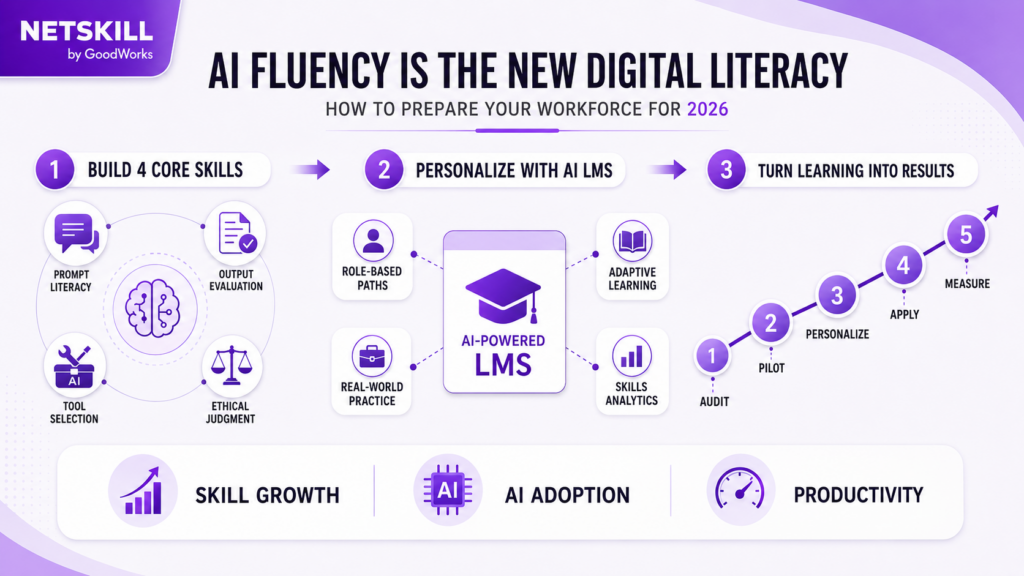
AI fluency in 2026 rests on four practical skill areas: prompt literacy, output evaluation, tool selection, and ethical judgment. Prompt literacy means knowing how to frame a request clearly enough to get a usable result on the first or second attempt, rather than relying on trial and error.
Output evaluation is the ability to spot inaccuracies, bias, or overconfident answers in AI-generated content before acting on them arguably the most important skill, since blind trust in AI output creates real business risk. Tool selection involves understanding which AI system fits a given task, since a writing assistant, a data-analysis model, and a coding copilot solve different problems. Ethical judgment covers data privacy, appropriate disclosure of AI use, and recognizing when a decision requires human sign-off. Workforce training solutions that teach these four areas together, rather than isolated tool tutorials, produce employees who use AI responsibly and effectively across changing tools and use cases and this is exactly the outcome a well-designed AI-powered LMS for corporate training is meant to deliver.
How Does an AI-Powered Learning Management System Personalize Training at Scale?
An AI-powered learning management system personalizes training by analyzing each employee’s role, prior learning history, and performance on assessments to shape a unique learning path automatically. Instead of pushing the same AI fundamentals course to a sales rep and a software engineer, the system adjusts content depth, examples, and pacing to match what each person actually needs.
This personalization also extends to timing and format. Some employees learn better through short, spaced-out microlearning modules; others need scenario-based simulations before a skill sticks. Adaptive engines within these platforms track engagement and comprehension signals in real time, adjusting difficulty or offering remedial content automatically rather than waiting for a manager to notice a gap. For large, distributed workforces, this scale of personalization would be operationally impossible to deliver manually, which is precisely why AI-driven personalization has become a core differentiator among corporate training services in 2026 and a key reason more companies are choosing an AI-powered LMS for corporate training over conventional platforms.
What Should Companies Look for in Corporate Training Solutions for AI Skills?
Companies evaluating corporate training solutions for AI skills should prioritize role-based content libraries, integration with existing HR and productivity systems, and built-in analytics that tie learning to performance outcomes. A platform that only offers generic AI courses without customization to specific job functions will struggle to drive real behavior change.
Integration matters because training that lives disconnected from daily workflows is easy to ignore; platforms that connect with tools like Slack, Microsoft Teams, or existing HRMS software keep learning visible and contextual. Analytics matter because leadership needs evidence that training investment is translating into skill growth, not just completion certificates. Look also for content that’s updated frequently, since AI tools and best practices evolve faster than traditional corporate curricula. Vendors offering an AI-powered LMS for corporates with configurable learning paths and compliance tracking tend to meet these requirements most completely, particularly for regulated industries a strong signal that the platform is a genuine AI-powered LMS for corporate training and not a repackaged generic e-learning tool.
How Can Organizations Measure ROI on Workforce Training Solutions for AI Fluency?
Organizations can measure ROI on AI fluency training by tracking three categories of metrics: skill assessment scores over time, adoption rates of AI tools in daily work, and downstream productivity or quality indicators tied to specific roles. Pre- and post-training assessments provide the clearest baseline for skill growth, while platform usage data shows whether employees are actually applying what they learned.
Productivity indicators vary by function faster ticket resolution in support teams, reduced editing cycles in content teams, or fewer manual data-entry errors in operations but all should be benchmarked before training begins so improvement is measurable rather than assumed. Employee confidence surveys add a qualitative layer, since self-reported comfort using AI tools often predicts sustained adoption better than one-time test scores. Workforce training solutions with built-in dashboards make this tracking continuous instead of a quarterly guessing exercise, giving L&D teams the evidence needed to justify further investment.
What Are the Steps to Build an AI Fluency Program Using Corporate Training Services?
Building an AI fluency program starts with a skills audit to identify current AI capability gaps by role, followed by selecting corporate training services that offer adaptive, role-specific content rather than generic modules. From there, organizations should pilot the program with one or two departments before a full rollout, using early feedback to refine content and pacing.
Next, integrate the training into existing workflows and performance conversations so AI skill-building feels embedded rather than optional. Set clear milestones for example, baseline proficiency within 60 days and applied competency within 90 and communicate them across teams to build accountability. Finally, establish a feedback loop between L&D and department leaders so course content stays aligned with how AI tools are actually being used on the ground. Programs that follow this sequence tend to see stronger completion rates and more durable behavior change than those that launch training company-wide without a phased approach.
Building AI Fluency Is No Longer Optional
AI fluency has become the baseline expectation for a capable, future-ready workforce, much like digital literacy was a decade ago. Organizations that invest now in structured, personalized training rather than waiting for skill gaps to show up in performance reviews will move faster and adapt more confidently as AI tools continue to evolve. The right platform makes this achievable without adding operational burden to already-stretched L&D teams.
If you’re ready to see how an AI-powered LMS for corporate training can close your organization’s AI skills gap, Book a Free Demo or Talk to Our L&D Team to build a workforce training plan tailored to your teams.