NetSkill Wins Google For Startups Grant Of $350k!
Learn More >
NEW
Check Genesis Turn any document to course in minutes
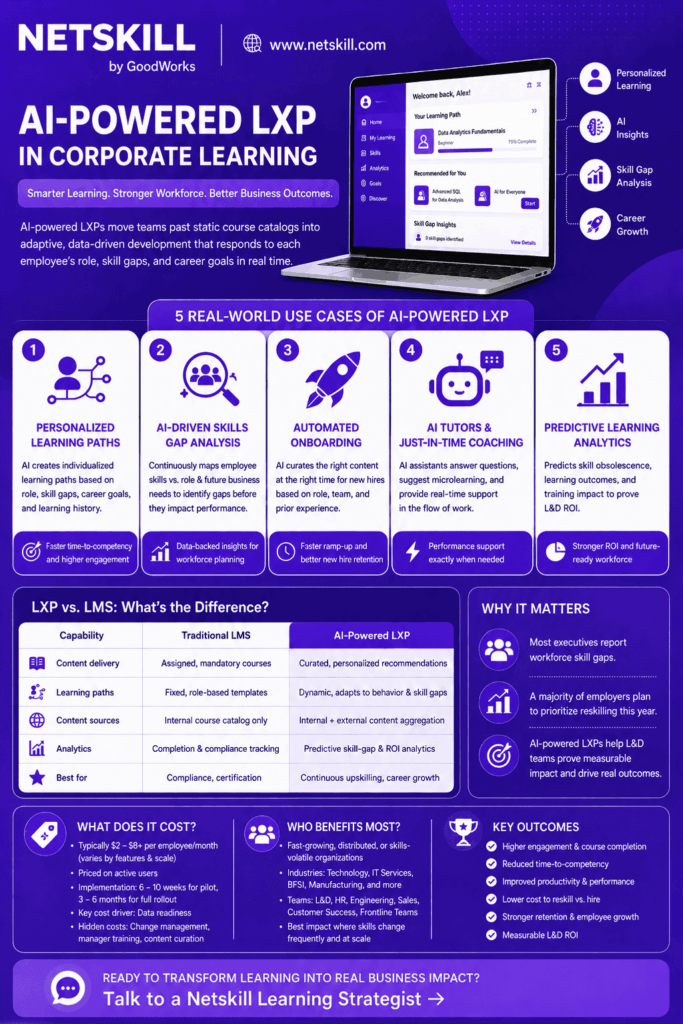
Corporate L&D teams are no longer treating AI as an experiment it has become the operating layer of how training gets delivered. An AI-powered LXP in corporate learning moves teams past static course catalogs into adaptive, data-driven development that responds to each employee’s role, skill gaps, and career goals in real time. With most executives already reporting workforce skill gaps and a majority of employers planning to prioritize reskilling this year, the pressure on L&D to prove measurable impact has never been higher. This guide breaks down five real-world use cases where AI-powered learning experience platforms are already changing outcomes personalized paths, skills-gap analysis, onboarding, AI coaching, and predictive analytics plus how an LXP differs from a traditional LMS, what it costs, and who benefits most.
What Makes an LXP “AI-Powered” in Corporate Learning?
An AI-powered LXP in corporate learning uses machine learning to personalize content recommendations, auto-map skills, and adjust learning paths based on real employee behavior instead of simply hosting and tracking static, assigned courses the way a traditional LMS does. It analyzes role data, prior learning history, performance signals, and stated career goals to decide what each person should learn next, rather than pushing the same catalog to everyone.
This shift matters because manual, one-size-fits-all training doesn’t scale across distributed teams. Industry data shows that organizations relying on generic catalogs see lower completion and weaker skill retention than those using adaptive, AI-curated paths. An AI-powered LXP essentially turns workforce data into a live recommendation engine for learning, continuously refining itself as employees progress, change roles, or pick up new responsibilities.
Use Case 1: Personalized Learning Paths Based on Role and Skill Gaps
The most common real-world application of an AI-powered LXP in corporate learning is generating individualized learning paths automatically from role data and skill assessments. Rather than assigning the same training to every new hire or team member, the platform identifies exactly what an individual is missing and routes them there directly, cutting time-to-competency significantly.
Large enterprises already use this approach internally recommending content based on role, career goals, and learning history rather than tenure or department alone. For organizations onboarding hundreds of employees across functions and geographies, building these paths manually simply isn’t realistic; AI makes role-based personalization operationally feasible at scale, and it directly addresses one of L&D’s biggest pain points: low engagement with generic, mandatory training.
Use Case 2: AI-Driven Skills Gap Analysis for Workforce Planning
AI-powered LXPs are increasingly used to run continuous skills gap analysis across an entire workforce, not just at the individual level. By mapping current employee capabilities against role requirements and future business needs, the platform flags exactly where teams are exposed before it becomes a hiring or delivery risk.
This matters because skills are changing faster than training cycles can keep up a large share of core skills required for the average job today are different from just a few years ago, and the gap is widening further with AI adoption. Yet very few organizations have a formal skills taxonomy in place, which is a prerequisite for this kind of analysis. An AI-powered LXP gives HR and L&D leaders a live, data-backed view of workforce readiness instead of relying on annual surveys or guesswork.
Use Case 3: Automated Onboarding and Faster Time-to-Competency
Onboarding is one of the highest-friction moments in corporate learning, and AI-powered LXPs are now used to automate the path from “new hire” to “fully productive” without overwhelming employees with irrelevant modules. The platform sequences content based on the new hire’s role, prior experience, and team, surfacing only what’s relevant at each stage.
This use case has direct retention value: employees who feel unsupported in their first few months are far more likely to disengage, and dissatisfaction with poorly scheduled or irrelevant training is one of the most cited complaints in recent workforce research. By automating relevance not just automating delivery an AI-powered LXP in corporate learning reduces the administrative load on managers while shortening the runway to full productivity for new employees.
Use Case 4: AI Tutors and Just-in-Time Coaching for Frontline Teams
A fast-growing use case is the AI tutor or conversational coaching assistant embedded directly inside the LXP, answering employee questions and surfacing relevant microlearning at the exact moment of need not days later in a scheduled session. This is especially valuable for frontline, shift-based, or distributed teams who can’t step away for long-form training.
Microlearning content under five minutes has seen a sharp rise in corporate adoption because it fits into the actual rhythm of a workday. An AI tutor inside an LXP can transcribe a meeting, summarize a process, or recommend a two-minute refresher based on what an employee just struggled with turning the platform into a continuous coaching layer rather than a once-a-quarter training event.
Use Case 5: Predictive Learning Analytics to Prove L&D ROI
L&D leaders are under constant pressure to justify training budgets, and predictive learning analytics inside an AI-powered LXP is how many are now doing it. The platform ties completion data, skill assessments, and on-the-job performance signals together to forecast which employees are at risk of skill obsolescence — before it shows up in business metrics.
The financial case is compelling: reskilling an existing employee typically costs meaningfully less than hiring externally for the same skill, and certified or upskilled employees often deliver measurable additional value to the business. Predictive analytics inside an LXP in corporate learning gives finance and HR a defensible, data-backed story for training spend, instead of relying on completion rates alone as the only success metric.
Get the Free L&D ROI Calculator →
How Does an AI-Powered LXP Differ from a Traditional LMS?
An LMS is built to assign, deliver, and track mandatory courses; an LXP is built to curate a personalized, self-directed learning experience that adapts to the individual using AI. The LMS asks “did the employee complete the course?” The LXP asks “what does this employee actually need to learn next, and from where?”
| Capability | Traditional LMS | AI-Powered LXP |
|---|---|---|
| Content delivery | Assigned, mandatory courses | Curated, personalized recommendations |
| Learning paths | Fixed, role-based templates | Dynamic, adapts to behavior & skill gaps |
| Content sources | Internal course catalog only | Internal + external content aggregation |
| Analytics | Completion & compliance tracking | Predictive skill-gap & ROI analytics |
| Best for | Compliance, certification | Continuous upskilling, career growth |
Many enterprises now run both: an LMS for compliance and certification tracking, layered with an AI-powered LXP in corporate learning for continuous, role-driven skill development. The two aren’t competitors they solve different problems.
What Does It Cost to Implement an AI-Powered LXP?
Pricing for an AI-powered LXP typically follows a per-employee, per-month model, with most vendors quoting based on active users rather than total headcount. Smaller deployments can start in the low single digits per user per month, while enterprise-wide rollouts with advanced AI features, integrations, and dedicated support sit considerably higher.
The real cost driver isn’t the license fee it’s data readiness. AI personalization is only as accurate as the role, performance, and skills data feeding it, so organizations with fragmented HR systems often need a data clean-up phase before launch. Implementation timelines for a focused pilot usually run 6 to 10 weeks, with phased rollout across departments extending to 3 to 6 months. Hidden costs to budget for include change management, manager training, and ongoing content curation.
Which Teams and Industries Benefit Most from an AI-Powered LXP?
Organizations with distributed, fast-growing, or skills-volatile workforces see the fastest payoff from an AI-powered LXP in corporate learning particularly technology, IT services, BFSI, and manufacturing, where required skills shift every few months rather than every few years. Companies onboarding at scale across multiple geographies also benefit disproportionately, since manual path-building simply can’t keep pace.
Within an organization, the strongest adopters are usually L&D and HR teams under pressure to show measurable upskilling outcomes, plus engineering, sales, and customer-facing teams where skill currency directly affects revenue or delivery quality. Smaller teams with a narrow, stable skill set see less incremental value, since the personalization engine has less variability to work with.
Final Thoughts on AI-Powered LXP in Corporate Learning
The five use cases above personalized paths, skills-gap analysis, automated onboarding, AI coaching, and predictive ROI analytics show that an AI-powered LXP in corporate learning isn’t a future concept; it’s already running inside organizations that needed training to keep pace with how fast skills are changing. The teams seeing results started small: clean data, one clear use case, then expansion. If your current LMS can’t tell you who is at risk of a skill gap before it shows up in performance reviews, that’s the signal it’s time to evaluate an AI-powered LXP.

NetSkill Enterprise Learning Ecosystem (LMS, LXP, Frontline Training, and Corporate Training) is the state-of-the-art talent upskilling & frontline training solution for SMEs to Fortune 500 companies.